Femtosecond laser-induced chemical etching (FLICE) technology is a method consisting of two steps: 1) modification of the sample with a femtosecond laser and 2) chemical etching of modified sample [1]. FLICE method is being used to obtain various microstructures in glassy materials for micro-/nanofluidics and biofiltering.
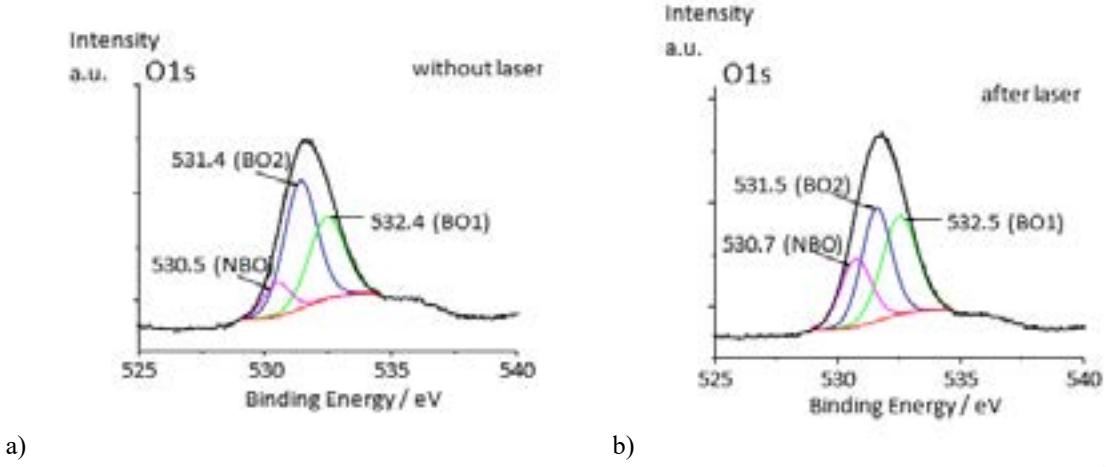
This technology has been and still is very promising in the processing of different glasses. Therefore, there is a need for a better understanding of the process itself at a molecular level. The X-ray photoelectron spectroscopy (XPS) is an analytical technique that is widely used for chemical characterization of solids. In the case of glasses, XPS provides information about the surface composition, surface chemical state and ratio of non-bridging oxygen (NBO) to bridging oxygen (BO) amount. Figure 1 illustrates the difference between the O 1s spectra of unaffected aluminum silicate sample (a) and the one after laser irradiation (b). There is an obvious decrease in bridging oxygen BO2, which corresponds to Si-O-Al bonds and increase in non-bridging oxygen peak after the laser treatment [2].
It is proved that laser modified areas are etched by base or acid solutions much faster than unmodified ones. The femtosecond laser pulses tear the bonds between silicon and aluminum atoms, which are connected by bridging oxygen atoms, increasing the amount of non-bridging oxygen in the structure of alkali glasses. These reactive oxygen species are most likely readily attacked by OH- ions in KOH etching solution. Therefore, the unchained oxygen is supposed to be the main reason for accelerated etching in the laser modified regions. Nevertheless, the parameters of the laser are very important as well, the pulse energy dictates the number of non-bridging oxygens created in the glassy structure.