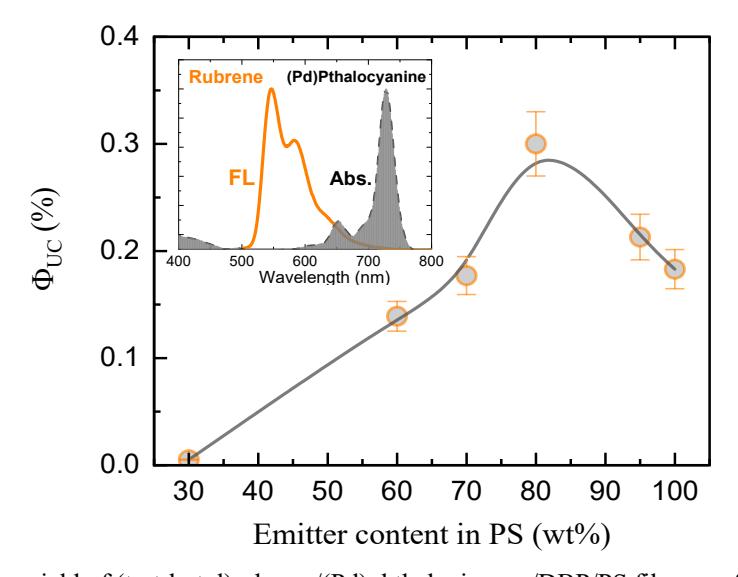
Triplet-triplet annihilation (TTA) mediated light upconversion (UC) achieved in organic compounds under incoherent low-power excitation are of particular interest as it offers numerous applications, e.g. in bioimaging, anti-counterfeiting, fingerprint detection, photocatalysis and photovoltaics [1]. In many instances, efficient TTA-UC is realized only in organic solutions, meanwhile the most applications including photovoltaics demand solid-state architecture. The additional UC layer in a solar cell can be employed to recover sub-bandgap photons that are beyond the absorption range of the cell thus improving its efficiency. Lack of efficient IR-to-visible rigid UC devices could be attributed to limited number of efficient triplet sensitizers in the IR range, which experience severe non-radiative losses as a result of small energy gaps [2].
The current work focuses on TTA-UC performance of solution-processed polymer films containing conventional and modified rubrene emitters and (Pd,Pt)phthalocyanine sensitizers. Expressing excellent photostability, efficient intersystem crossing and long triplet-state lifetimes [1] the novel phthalocyanines are shown to exhibit strong Q-band absorption (up to 2.5 105 M/cm) at about 720 nm and broad transparency window at 450 - 630 nm (see inset of Fig. 1) suitable for the UC emission. These properties along with the determined triplet energies (1.12 - 1.18 eV) of the phthalocyanine sensitizers ensure their suitable combination with rubrene emitters for UC application. Rubrene was modified with tert-butyl side groups to preserve high emission quantum yield ($\Phi_{FL}$) at high concentrations, which are required for efficient triplet diffusion and thus TTA. Since the UC system is sensitive to oxygen, UC polymer films were fabricated by spin-coating on pre-cleaned glass substrates in nitrogen glovebox (with O2 and H2O level < 0.1 ppm) and encapsulated with epoxy resin. Additional lower-energy DBP emitter introduced into the UC films (at a concentration of 0.5 wt%) served as a singlet exciton sink allowing to reduce detrimental singlet fission effects in the emitter. The achieved UC quantum yields (Fig. 1) are rather promising and encourages further development of rigid IR-to-VIS upconverting films.