
Nowadays the scientific research and experiments in the infrared (IR) attract a lot of interest as it is a promising area of high intensity laser physics, e.g. attosecond pulses generation [1]. However, even some parameters of optical materials used in the IR, are not well known. One of the most important parameters facilitating nonlinear phenomena is nonlinear refractive index or n2.
In this work, determination of nonlinear refractive index using a standard z-scan [2] technique for various samples - fused silica, sapphire, BK7 and KGW are presented. The z-scan experiment was carried-out using femtosecond laser sources at infrared wavelengths.
The z-scan technique allows to easily determine nonlinear refractive index (NLR) sign and magnitude as well as the impact of nonlinear absorption (NLA). The z-scan measurements are performed by translating the sample along the beam propagation axis and measuring the phase variation behind the aperture with a detector. A typical closed aperture z-scan shows characteristic valley-peak curve which indicates positive n2 sign. Nonlinear refractive index is determined from phase change ($|\Delta \varphi|$) which is calculated from normalized transmittance curve difference between valley and peak. ($\Delta T_{p-\nu}$) (Eq. (1,2)).
$$|\Delta \varphi| = \frac{\Delta T_{p-\nu}}{0.406(1-S)^{0.25}} \tag{1}$$$$n_2 = \frac{k\Delta \varphi_0}{I_0 L_{eff}} = \left(\frac{\lambda}{2\pi}\right) \frac{\Delta \varphi_0}{I_0 L_{eff}} \tag{2}$$Here S is linear transmission of an aperture, $I_0$ - peak intensity, $L_{eff}$ is effective sample length. The z-scan experimental setup for evaluation of the n2 was developed, see Fig. 1. Here S - sample, $\lambda/2$ - half wave-plate, P1, P2 - Brewster type polarizers, L1, L2 - focusing lenses, BS - beam splitter, M - metal mirror, A - aperture, D1, D2 - detectors, F1, F2 - neutral density filters.
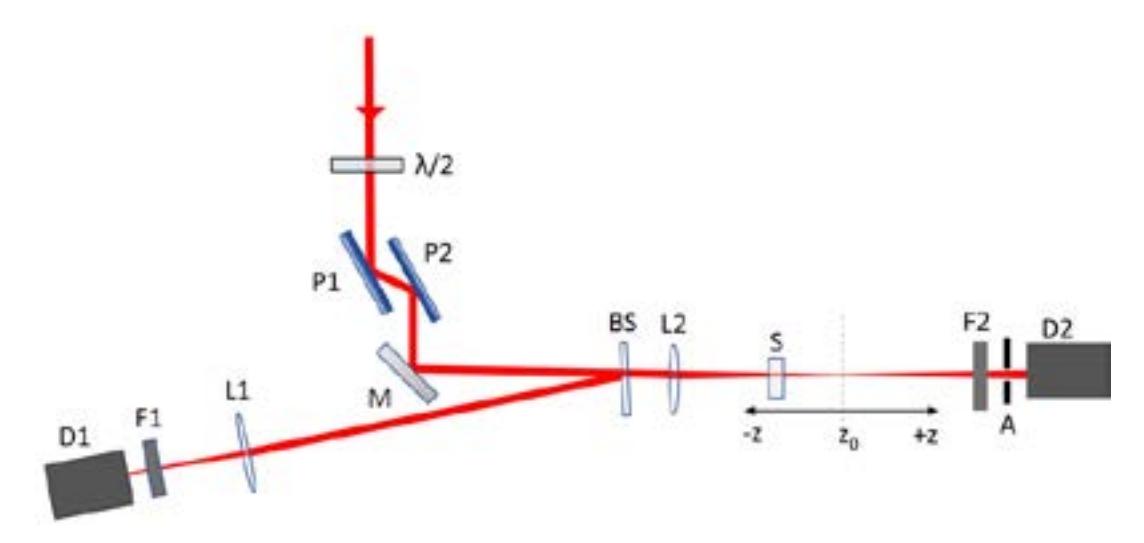
The investigated optical materials were translated using a motorized delay line and the whole process of signal acquisition was automated and controlled via a LabView based program. From the closed and open aperture z-scan measurements, the nonlinear refractive index for fused silica, sapphire, BK7, KGW and AGS were determined and compared.