
The compounds from the diamondoids family (including adamantane as a simple diamondoid) and their derivatives have long been known as the good candidates for drug design, drug delivery and drug targeting. The incorporation of an adamantyl moiety into organic compounds modulates their biological activities due to increase of the lipophilicity, which is promoting transport through biological membranes [1].
In this study, the structures of four adamantane-based derivatives, namely N'-(adamantan-2-ylidene)-R-hydrazides (where R = thiophene-2-carbo-, adamantan-1-, benzo-, and pyridine-5-) have been obtained at the DFT level of theory (B3LYP/cc-pVTZ) calculations. All of them demonstrate existence of four stable conformers (Fig. 1): two "regular" trans- and cis-conformers (for C=O and N–H bonds) and two “side” trans-conformers, which correspond to left and right positions of the adamantyl moiety relatively molecular “frame” (i.e. rotation around N-N bond). It is assumed that for the crystalline phase an “open” configuration of the chain of the “regular" trans-isomers is more favorable. In this case each of the trans-isomers connects with two (or more) of its neighbors. Note that in crystalline phase "side" conformers do not exist due to steric distortions. In contrast, for solutions all above-mentioned conformers can exist. It is also worth mentioning that “side" conformers are typical only for adamantane-containing compounds, because calculations of the model structures without adamantyl group did not confirm the stability of the “side” conformers.
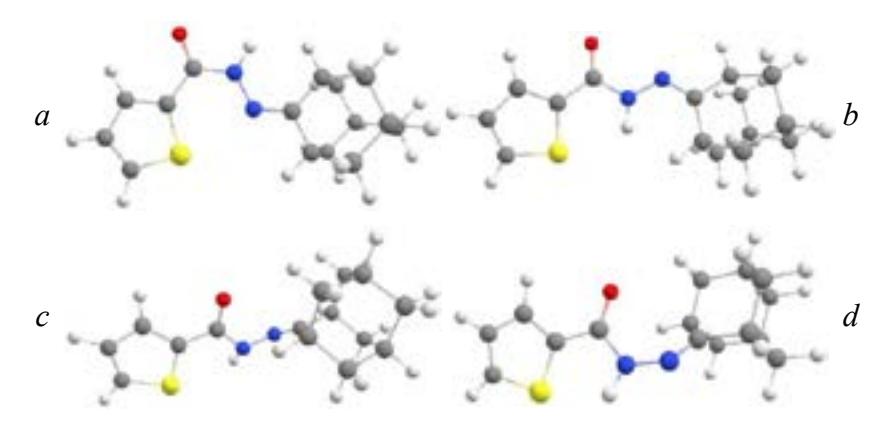
The structure of the title molecules allows one to classify their as molecular systems that may exhibit the intramolecular charge transfer (ICT). Then ab initio multi-reference SA-CASSCF/XMCQDPT2 [2] calculations for all conformers of all compounds were performed using cc-pVTZ basis set. Firstly the CASSCF calculations with state-averaged procedure were done for singlets and triplets. The active space comprises 4 electrons and 6-8 orbitals. Finally the calculations for singlets were performed at the XMCQDPT2 [2] level of theory.
The "side" conformers exhibit the more long-wave $S_1 \leftarrow S_0$ transitions than "central" ones. The differences in the values of the excitation energy for the "side” and “central” conformers may be caused by different positions of the adamantyl moiety relative to the molecular “frame”, leading to the differences in the values of the transition moments and their orientations relative to the molecular coordinate axes. Such regularities find confirmation in the UV/Vis spectra of the solutions of compounds under consideration in ethanol. Analysis of the Mulliken and Löwdin populations shows that long-wave transitions are related with partial charge transfer. For example, in N'-(adamantan-2-ylidene)-pyridine-5-hydrazide ITC occurs from N atom to neighbor C atom in pyridine ring.
In continuation to our interest in the pharmacological and structural properties of the adamantane derivatives, the coexistence of all conformers should be taken into consideration when studying the pharmaceutical properties of such compounds and it may be useful in medicinal chemistry and for a drugs design.