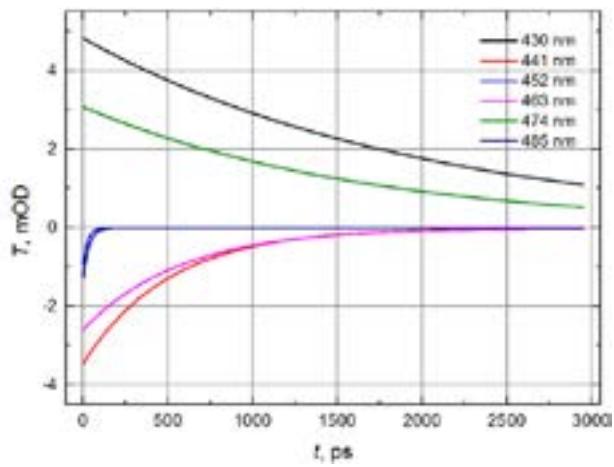
Recombination processes of excess carriers play a key role in optoelectronic device operation and thus must be well understood. A very attractive tool for this task is optical pump-probe technique, because it provides means for direct observation of carrier relaxation processes in a semiconductor on ultrafast time scales. Pump-probe measurements in thin semiconductor layers have to deal with the light interference effects due to multiple reflections from the layer surfaces. These effects are known to distort the carrier relaxation kinetics tremendously which is particularly noticeable in two-color pump-probe experiments (Fig. 1.).
In this work, the excess carrier temporal evolution in GaN and InGaN layers as well as GaN/InGaN quantum wells was investigated. In order to eliminate the negative light interference effects, a pump-probe setup with spectrally resolved broadband probing was used for recording the differential transmission interference spectra in the transparency region at various probe delay times. The density of excess carriers at each delay time was obtained by modelling the experimental data. The model was based on the transfer matrix method and took into account the geometrical properties of the layer, its wavelength-dependent refractive index as well as the carrier-induced refractive index change. The change in refractive index depends solely on the concentration of excess carriers, making it the only variable parameter in the model.
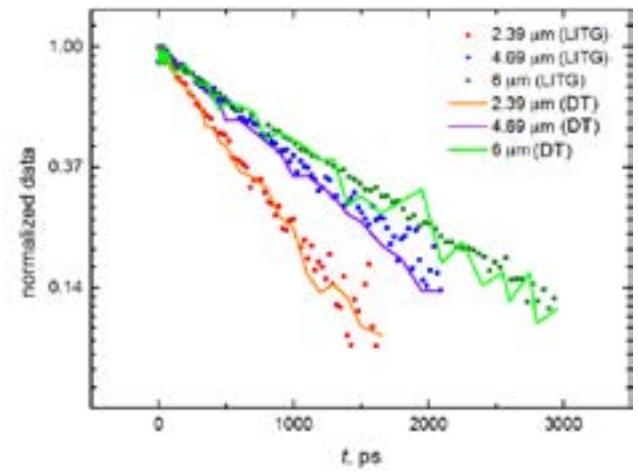
Calculations performed using the aforementioned method resulted in carrier relaxation kinetics, unaffected by the negative effects of light interference. These kinetics were compared with the kinetics obtained by other methods, namely, the light-induced transient grating (LITG) and differential transmission (DT) performed near the absorption edge, and were found out to be in close agreement with each other (Fig. 2.).
The model also allowed evaluating the initial excess charge density generated by the pump beam of different intensities at the surface of the investigated GaN and InGaN structures, as well as the excess carrier lifetime dependence on the excitation intensity and layer thickness.