
The growing consumption of fossil fuel cause the increasing pollution and greenhouse gas emissions. To resolve this issue, subsequent studies focused on finding environmental friendly ways to produce energy from renewable sources are being conducted. One of the possible solutions could be Solar energy which is converted into electricity via solar cells. During the last decade, perovskite solar cells (PSC) have received considerable attention as promising photovoltaic devices for efficient light to power conversion. In PSCs hole transporting layer plays an important role in increasing power conversion efficiency (PCE). Currently spiro-MeOTAD is the most efficient small organic molecule hole transporting material (HTM) which allows reaching PCE up to 22%. [1] However this molecule is characterized by low conductivity of carriers and requires oxidative additives to boost performance in the devices, however, using additives results in PSC long-term stability problems. [2]
Many researchers investigate new organic HTMs which could be used in PSC construction without any additives enabling high PCE without the loss in device stability. For this purpose N.Giuseppone et al. studied triphenylamine derivatives containing amide moiety. The chemical structure of these derivatives allow the molecule to self-assemble into ordered supramolecular architectures under light irradiation which enhance conductivity. [3] The weak Van der Wals forces, hydrogen bonds and $\pi$-stacking found in these particular supramolecular structures are sufficient to hold the structure together in solution or under gentle film deposition conditions, but break when manufcturing films using spin-coating technique. S. Y. Kim group have reported work on triphenylamines containing diacetylene moieties allow photoinduced self-assembly of the molecules into aggregates by visable light and subsequent covalent fixation via polymerization by UV irradiation. [4]
The aim of this this work was to synthesize and investigate new organic HTMs containing triphenylamine-core, amide and styrene moieties. These molecules have a tendency to self-assemble into orderly structures under exposure to light in the chlorinated solvents.
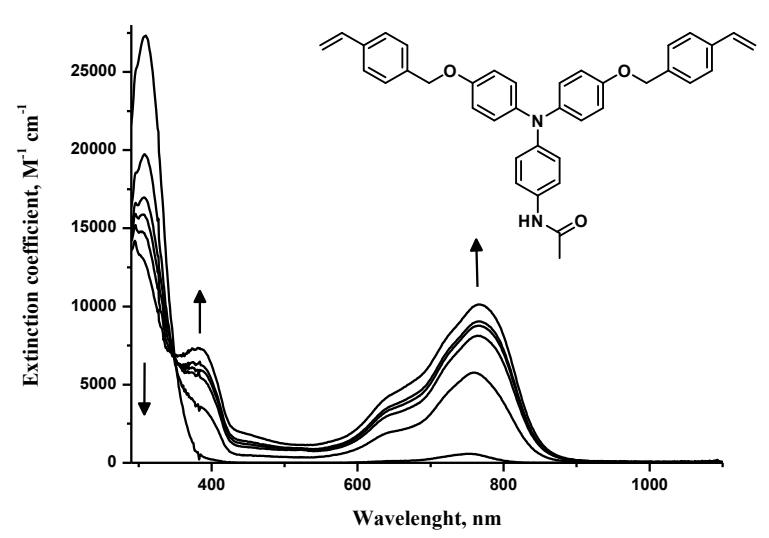
The self-assembly process of HTM1 can be observed in UV/Vis/NIR spectroscopy where new absorption bands appear: 770 nm and 384 nm, while absorption band 308 nm decreases in 1,1,2,2- tetrachloroethane solution under visible light irradiation. To photopolymerization of HTM1 was initiated using photoinitiators and UV irradiation. The molecules synthesized in this work are thermally stable and possess suitable ionization potential for application in PSC.