Many applications such as laser-induced damage testing, laser microfabrication and modification of materials sometimes require a train of defined number of ultrashort pulses with special shape energy envelopes [1]. Such pulse trains could be obtained using pulse picker systems based on electro-optical Pockels elements. Pockels cells are devices that create a phase delay in a crystal which can be modulated by applying a variable electric voltage [2]. Beta barium borate (BBO) crystals are a suitable material for Pockels cells due to their wide transmission range, high optical damage threshold and thermal stability [3, 4]. However, unwanted resonance effects can occur in Pockels elements which depolarize passing laser radiation and thus significantly reduce the efficiency of pulse picker device by reducing the contrast ratio. Knowledge of resonance conditions and optical contrast ratio dependence on high voltage control signal characteristics are relevant factors to ensure a stable selected laser pulse train.
In this work resonance effects were investigated in a special pulse picker "MP1" which was designed and made by Lithuanian company "Optolita" and used various BBO Pockels cells. Pulse picker “MP1” can output 100 ns – 1 ms duration synchronized selected laser pulse trains with repetition rate of 10 Hz – 250 kHz. The dependence of the contrast ratio of various BBO Pockels cells on the high-voltage control signal frequency and duration was investigated in this study. An Yb:KGW oscillator “Flint” generating 1033 nm wavelength, 76 MHz repetition rate and 110 fs pulses was used as a laser source. Four different BBO Pockels cells were measured; two of them had technological improvements, which aimed to reduce piezoelectric oscillations.
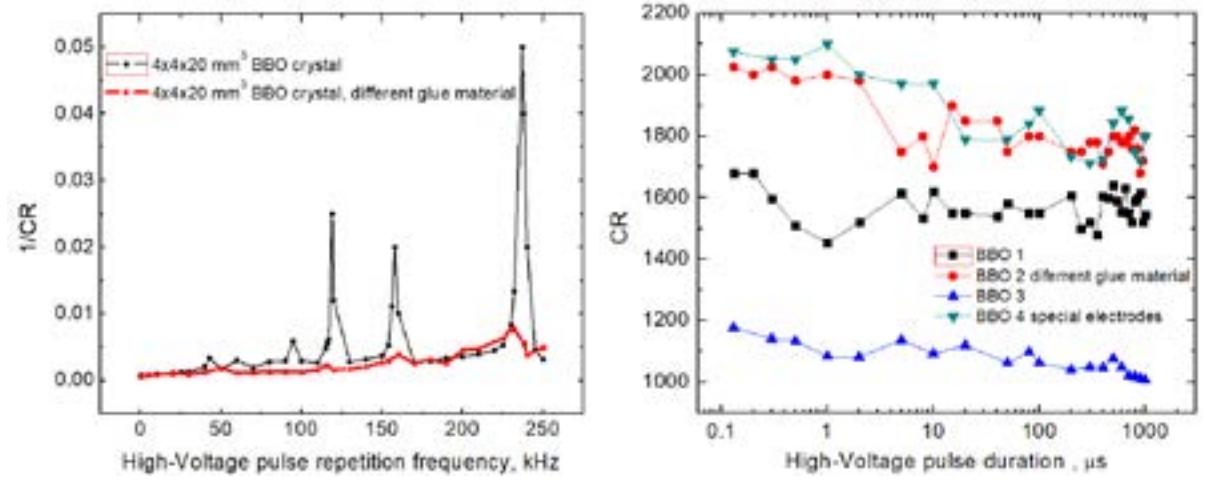
All of the measured BBO elements suffered from piezoelectric oscillations and piezoelectric resonances. It was determined that resonance effects – inverse piezoelectric effect, acoustic wave propagation in the crystal and photoelastic effect, cause high amplitude piezoelectric oscillations which reduce Pockels cell optical contrast ratio by 6 – 70 times at resonance frequencies. By comparing different BBO Pockels cells we showed that optical contrast ratio is 1.5 – 5 times greater with Pockels cells that use different glue and special electrodes with a notch (Fig. 1). Finally it was determined that at low high-voltage control pulse repetition frequencies (up to 10 Hz), BBO Pockels cells are free of high amplitude piezoelectric oscillations and resonances when high-voltage control pulse duration is from 100 ns to 1 ms. In such case optical contrast ratio is stable and higher than 1:1000 (Fig. 2).