ZnO nanowires (NWs) have attracted a great deal of interest due to their exceptional properties and application for various electronic, photonic, biological, and energy related usage [1-2]. ZnO tetrapods (Ts), as more sophisticated forms of NWs, can be grown by simply controlling the crystal grow direction of ZnO. Among others (hydrothermal processes or chemical vapor deposition), a direct growth of ZnO Ts from Zn vapor is a highly attractive synthesis method with advantages of being a simple and high yield process. However, the control of concentration for uniform structures is still challenging.
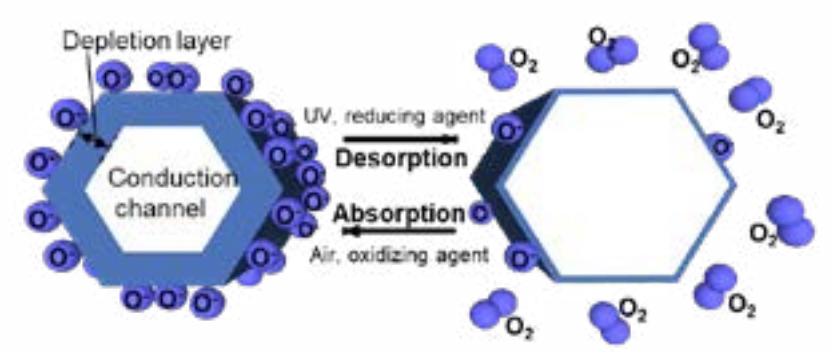
Applicability of the ZnO Ts can be used as efficient UV sensors. ZnO NW sensing application is interesting by its high surface ratio which provides an enhancement of the surface effects. The main principle of sensing is to get a measurable response (mostly electrical) from the added substance. High sensitivity (response to extremely small amounts), selectivity (ability to differentiate between various substances) and linearity (for instance, response is linear amount of substance measured) are the main parameters for efficient sensors [3]. UV sensor response is associated with the depletion layer width. When illuminating ZnO Ts with a wavelength, higher than the ZnO bandgap (3.37 eV for ZnO), photogenerated holes combine with the negative O2 ions, inducing desorption and increasing the conductivity.
In this work, ZnO Ts were synthesized in a continuous flow reactor by a gas phase oxidation of Zn metal vapor in an air atmosphere. No catalysts were used at any stage of synthesis. To produce ZnO T structure of nanometer size, a few experimental parameters had to be carefully controlled: Zn vapor at relatively high concentration must be quickly mixed with O2, whereas the growth time should be kept minimal to avoid the thickening of the ZnO T legs. Thereby, the synthesis reactor was based on the combustion of Zn micron-sized particles in an open reactor in the air atmosphere. These allowed to rapidly evaporate Zn, to oxidize Zn vapor by surrounding air oxygen, and to form ZnO Ts by supersaturated ZnO vapor condensation. It was shown that morphology of ZnO Ts can be adjusted by Zn vapor pressure in the reactor by changing the evaporation temperature. The highest aspect ratio of single crystal ZnO T structure was obtained at 700 °C.
Finally, ZnO tetrapods showed high current increase under UV irradiation thus demonstrating potential application possibilities for transparent and flexible UV sensors.