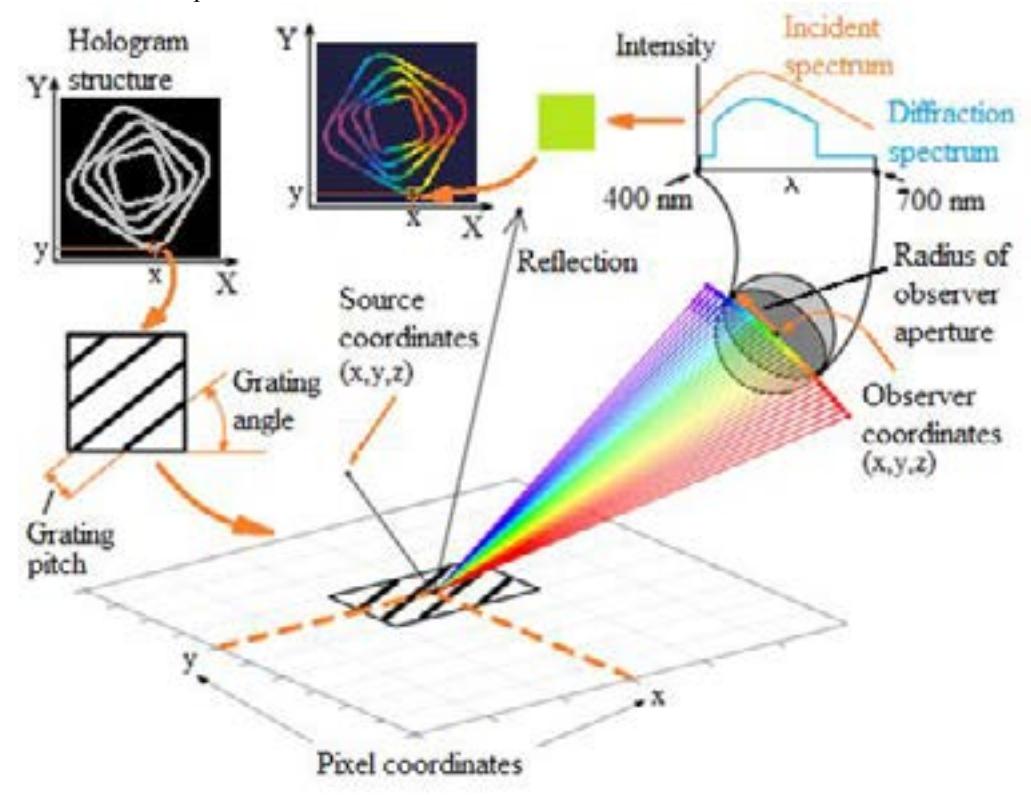
Holographic security labels create colorful images when illuminated and are widely used for anti-counterfeiting applications. One widespread technology to realize such labels is dot-matrix holograms [1]. A dot-matrix hologram typically consists of a two dimensional array of spots that contain diffraction gratings with selected pitch and orientation imposed on a reflective surface. When the holograms are viewed by the observer under arbitrary illumination the off plane light diffraction from the hologram is actually seen and it can be described employing conical diffraction formalism [2]. Due to the complex nature of diffraction description it is difficult to determine the hologram parameters (each pixel diffraction grating pitch and orientation) before beginning their lengthy production procedures.
The problem of hologram diffraction image rendering on known hologram parameters and illumination conditions has already been solved [3]. This work explores the reverse – determination of parameters necessary to ensure that the produced hologram would look exactly as the selected colored target image under known illumination and observation conditions. Such an algorithm has a range of practical applications in the fields of dot-matrix hologram design and authorization.
The proposed algorithm considers the parameters of the target hologram image itself such as CIE 1931 colour coordinate of each pixel from a selected digital image as well as the hologram illumination conditions such as the angle of incidence and spectrum of incident light along with observation conditions of the hologram like the position of the observer and the observers' aperture diameter.