
In recent years, Intermediate Mass Black Holes (IMBHs) (with masses between $100 - 10^5 \, \rm M_{\odot}$ ) attracted wide attention due to importance in understanding how the black holes at various masses are formed, in particular the super-massive ones seen in quasars [1]. It is presumed that they can be formed by various occurring phenomena, including direct collapse of unpolluted gas in very massive stars [2], from compact stellar clusters [3] and some can even originate from the mysterious dark matter and potentially be partially responsible for the dark matter content of the Universe. So far, there has been no robust detection of IMBH, with only a couple of candidates suggested [4].
One of the most novel techniques to detect and characterise IMBHs is gravitational microlensing phenomenon [5, 6], which is presented in Fig. 1.
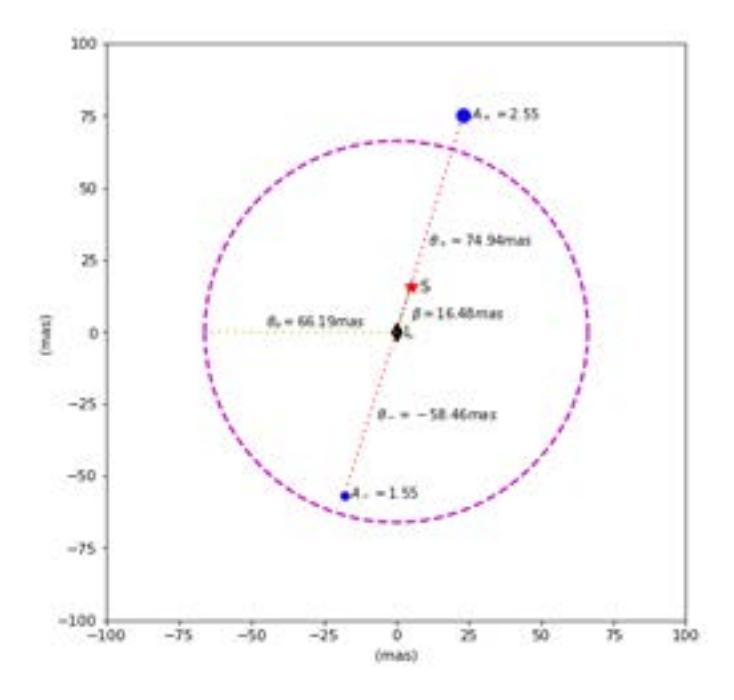
In this research, we are analysing ultra-precise astrometric data from Gaia space mission and from VLTI. If a black hole acts as a gravitational lens, it creates two images of the background source (Fig. 1), in the Milky Way these will be just stars of our Galaxy. Separation of the images depends on the mass of the lens, but even for an IMBH, they are unresolvable if observed with typical instruments (separations up to 100 milli-arcseconds). ESA's mission Gaia is the best of them since it also observes the entire sky, hence can provide candidates from all over the sky [7, 8]. The observations can be followed-up with ESO's VLTI optical interferometer GRAVITY that provides milli-arcsecond angular resolution in near infrared wavelengths. An interferometric instrument GRAVITY is used for interferometric imaging, as well as for astrometry [9]. Two independent systems: fringe tracking (FT) and infrared wavefront sensing system (CIAO) help to correct automatically the residual optical path difference between the beams [9]. This concept will be presented for optical interferometry, regarding to VLTI.
We hope to discover first cases of IMBHs in the Milky Way by using gravitational microlensing phenomenon.