Gallstone disease is one of the major health problems which can cause cancer. Thus it is very important to remove gallstones in the early stages [1]. Currently used surgical gallbladder removal causes damage and complications but the use of non-surgical methods causes recurrence of gallstones [2]. In order to find new ways for the treatment of gallstone disease it is very important to know the composition and mechanisms of gallstone formation.
In this work Raman spectra of gallstones removed from different age men and women were analyzed. After spectral analysis it was established that cholesterol, phospholipids, fatty acids, proteins, calcium carbonate, calcium oxalate, calcium bilirubinate, bilirubin, biliverdin can be found in all types of gallstones. The gallstones were classified based on qualitative analysis of Raman spectra. The intensities of characteristic bands of cholesterol and bilirubin were compared and gallstones were classified into two major groups – cholesterol gallstones and pigment gallstones. The group of cholesterol gallstones included stones with the most intense spectral bands in the 3036 – 2850 cm-1 spectral range. Pigment gallstones were identified according to the spectral band at 1618 cm-1, which is assigned to bilirubin and calcium bilirubinate. One cholesterol gallstone had high intensity bands at 1087 cm-1, 205 cm-1, 153 cm-1 which show a high content of calcium carbonate in the composition. According to this difference, cholesterol-carbonate gallstones were classified into a separate group. Spectral differences between pigment stones were also observed. Pigment gallstones were divided into two smaller groups: brown and black stones. Black gallstones had high intensity bands at 1087 cm-1, 282 cm-1, 153 cm-1 that are attributed to calcium carbonate. These bands were not observed in brown gallstones. After classification of gallstones it was determined that 82 % of samples were identified as cholesterol gallstones.
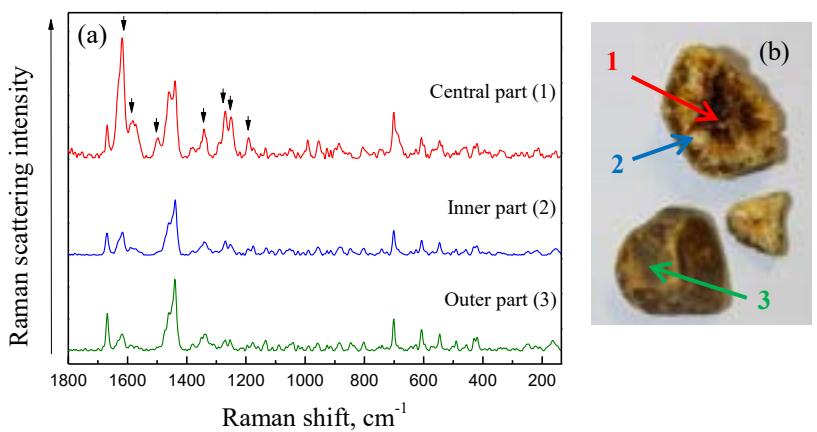
While the reason and mechanism of the formation of cholesterol monohydrate crystals are still unclear, it is proposed that this process is influenced by the presence of glycoproteins (mucin), calcium bilirubinate and bilirubin [3]. Calcium bilirubinate promotes formation of the gallstone crystal; mucin influences the balance of bile salts, leading bilirubin to bind with lipids and form cholesterol monohydrate crystals. After visual examination of cholesterol gallstone samples, it was observed that cholesterol gallstones have specific layered structure (Fig 1b). The differences of chemical composition between different gallstone layers were observed in Raman spectra (Fig 1a). The spectrum of the central part of the gallstone has high intensity bands that are attributed to bilirubin (1618 cm-1, 1497 cm-1, 1192 cm-1, 1338 cm-1) and calcium bilirubinate (1618 cm-1, 1581 cm-1, 1497 cm-1, 1192 cm-1). The intensity of bands at 1270 cm-1 and 1254 cm-1 may increase due to increased amount of the calcium bilirubinate or bilirubin. However, increased intensity of the band at 1270 cm-1 may be attributed to a higher amount of phospholipids, while increased intensity value of the band at 1254 cm-1 may be attributed to a higher amount of proteins. The decrease of intensity of all these bands is observed in Raman spectra from the inner and outer parts of the cholesterol gallstone (the bands are marked with arrows in Fig 1a). The high intensity bands of bilirubin, calcium bilirubinate, phospholipids and proteins observed in the Raman spectra of the central part of the samples show that these substances affect the formation of the crystal of the stone and formation of the cholesterol monohydrate.