Medical, electronic, and photonic industries demand fast and high-quality processing of glasses. Modern ultra-short pulsed lasers offer high average power at high-pulse repetition rates allowing fast production of high-quality parts. However, full laser potential is rarely used during the glass cutting applications. Laser parameters, such as scanning speed, pulse energy and pulse repetition rate are limited to avoid glass overheating and generation of cracks. In extreme cases, excessive laser power can even lead to a fracture of the workpiece.
Rear side drilling [1], crack generation in the bulk of the glass material [2], and direct ablation [3] are the main laser processing technologies used for glass cutting. The fastest ones are the rear side drilling and the crack-generation in the bulk of the glass material. However, these two have limitations, such as low capability in the manufacturing of small and complex shape parts, and low processing quality. Therefore, the most versatile technology seems to be the direct ablation of glasses. However, direct ablation frequently suffers from the low processing speeds due to the channel clogging with laser generated debris.
Studies have shown that the water layer introduced onto the surface of the workpiece could improve both the process quality and the laser cutting speed [4, 5]. Therefore, water-assisted processing attracted much attention in laser drilling, grooving, scribing, and cutting applications [5].
In this research, picosecond laser working at 1064 nm and 532 nm wavelengths was used to evaluate the direct laser ablation efficiency and process quality of soda-lime glass samples in ambient air and water-assisted environments. Ablated grooves and complete cutting of glass plates were investigated. A water spray was used to introduce a thin flowing water layer in the laser ablation zone.
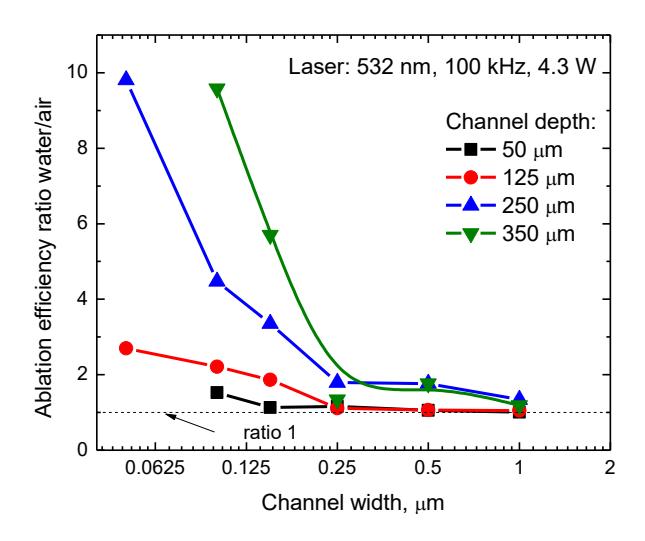
Results showed that the applied water layer improved the ablation efficiency of grooves deeper than 250 μm or narrower than 150 μm (see Figure 1). At optimal conditions, water improved the glass ablation efficiency 11 times compared to the ablation in ambient air, reaching 0.19 mm3/min/W. Finally, applied water layer improved the cut-line sharpness and reduced the chipping of glass material at the edges of the groove.