
Copper sulfide (CuxS) is wide-band-gap p-type semiconductor material with modern applications ranging from industrial to biomedical. Various polymers, modified by copper sulfides, represent a new class of materials – composites with novel properties. CuxS is an interesting material for its metal-like electrical conductivity, chemical-sensing capability and ideal characteristics for solar energy absorption. Consequently, polymers modified by CuxS are used: as the conductive substrates for deposition of metal and semiconductors; as gas sensors functioning at temperatures tending to room temperature; as polarizer of infrared radiation; and as active absorbents of radio waves.
Electrically conductive CuxS films can be prepared by the chemical bath technique or sorption-diffusion methods [1-3]. Polyamide (PA) as semi-hydrophilic polymer is capable to absorb ions or molecules of various electrolytes from aqueous and non aqueous solutions.
CuxS thin films were deposited on PA (Tecamid 6, density 1.13 g·cm-3, 500 μm thick) using CuCl2 and Na2S2O3 mixture for 16 h. The deposition process was carried out by repeating such deposition cycles till 3 times.
The aim of this work was to obtain CuxS thin films by the chemical bath deposition method and determine the effect of variation of number of cycles of deposition on the optical properties with a view to ascertaining the possible applications. The UV-Visible absorption spectroscopy is a powerful tool for the investigation of optical properties of material. Absorbance of the films was characterized using PerkinElmer Lambda 35 UV/VIS spectrometer. The absorption spectrum for copper sulfide thin films was recorded in the wavelength region from 200 nm to 1100 nm.
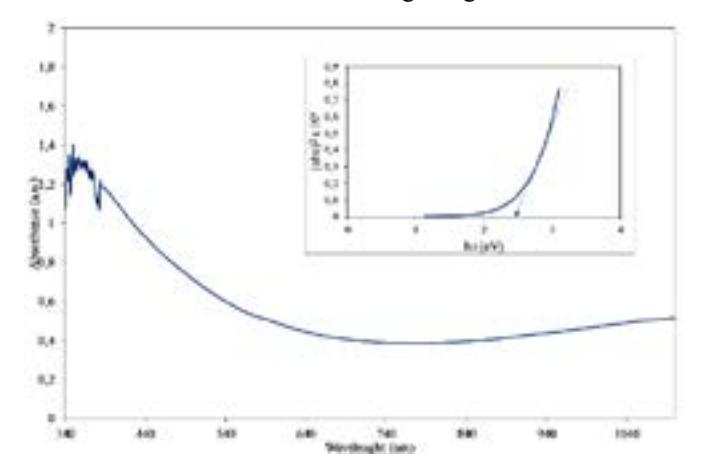
Fig.1 shows that absorbance of CuxS films (after 3 cycles of deposition) is generally high in the UV region (300-400 nm) and low absorbance in the visible spectrum (400-765 nm). This makes the films suitable for coating of eye glasses to prevent UV radiation from getting to the eyes. It is also useful for coating of windows to prevent UV radiation and aid visibility since absorption in the visible region is low. Low absorption in the visible region makes it a veritable material for buffer layer in solar cell. The absorbance of the films is directly proportional to number of cycles of deposition.
The optical bandgap of the CuxS thin films was determined from the absorption spectra using Tauc's relation
$$ \alpha h \upsilon = A(h \upsilon - E_{g})^{n} \tag{1} $$where hv is the photon energy, $\alpha$ – optical absorption coefficient, Eg - the optical energy bandgap, A – the optical transition dependent constant, and n – characterizes the transition. For allowed direct transitions, n = 2 and allowed indirect transitions, n = 1/2. Fig. 1 shows the plot of $(\alpha hv)^{2}$ against hv. The variation of $(\alpha hv)^{2}$ with hv is linear which indicates that the direct transition is present. Extrapolating the straight line portion of the plot of $(\alpha hv)^{2}$ against hv to energy axis for zero absorption coefficient give optical bandgap energy value as 2.5 eV. The films were found to have average transmittance of about 40 % in the UV-VIS regions while exhibiting average reflectance of about 20 % in the same regions. Some of the films could be effective for solar control, eyeglasses, and as well good materials for solar cell fabrication.