
Nitrogen - Vacancy (NV) centers in diamond crystals are used in wide range of applications, such as quantum information, magnetometry and nanoscale sensing [1]. It is important to know the level structure of the NV center, including its hyperfine structure, which arises from interaction of the electron spin and the nuclear spin of 14N atom, which is part of NV center.
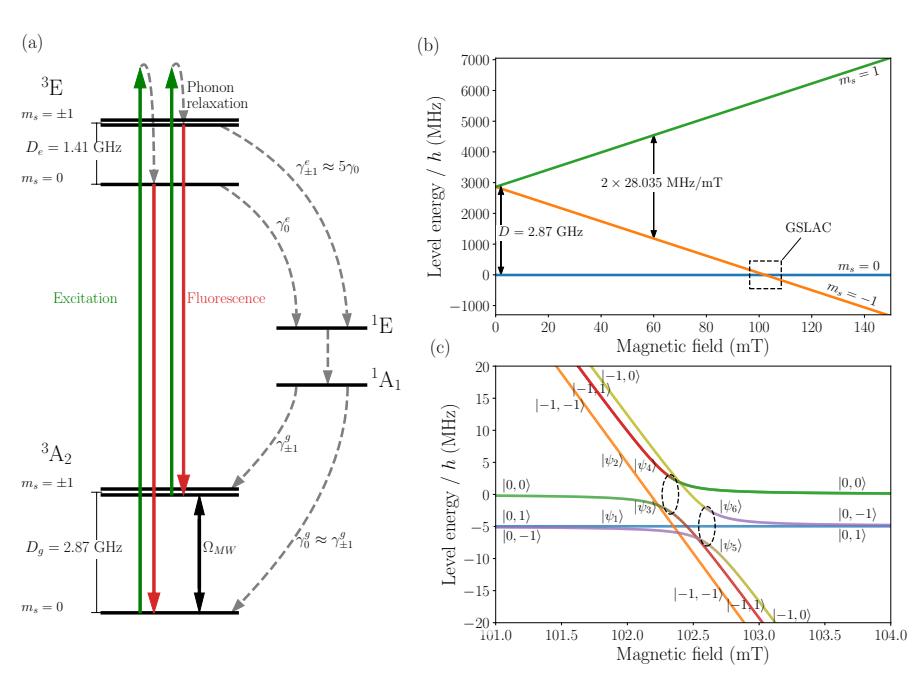
NV centers are defects in diamond crystal consisting of paired nitrogen (N) and vacancy (V). The NV center has a triplet ground state with a zero-field splitting between the $m_s=0$ and $m_s=\pm 1$ ground state sublevels of 2.87 GHz (Fig. 1a). Due to nonradiative decay path from the excited state via singlet state that preferentially populates the $m_s=0$ ground-state sublevel, the NV center can be polarized optically, and the fluorescence from exciting $m_s=0$ sublevel is more intense than the fluorescence from exciting the $m_s=\pm 1$ sublevels. In presence of microwave field population of $m_s=0$ can be transferred to $m=\pm 1$ levels, decreasing the total detected fluorescence.
In this study, we used a straight froward method of optically detected magnetic resonance (ODMR), to investigate the ground state $m_s = 0 \longrightarrow m_s = \pm 1$ electron spin transitions (Fig. 1b) and to study the hyperfine level structure of NV-center ensembles in the vicinity of the ground state level anti-crossing (GSLAC) (Fig. 1c).
As an addition to hyperfine interaction, we considered interaction with nearby 13C atoms for diamond crystals with natural 13C abundance 1.1% [3]. We calculated superhyperfine interaction between NV center 13C atoms in a lattice consisting $3 \times 3 \times 3$ unit cells. The full Hamiltonian of the system can be written as
$$\hat{H} = \hat{H}_{el}+\hat{H}_N+\hat{H}_C+\hat{H}_{N+el}+\hat{H}_{NV+C},\tag{1}$$where $\hat{H}_{el} = D_g \hat{S}_z^2 + \gamma_e \mathbf{B} \cdot \hat{\mathbf{S}}$ describes the ground state of the NV center with electron spin $\mathbf{S}$, $\hat{H}_N = Q\hat{I}_z^2 - \gamma_N \mathbf{B} \cdot \hat{\mathbf{I}}$ describes the 14N nucleus with spin $\mathbf{I}$, $\hat{H}_C = \Sigma_j \gamma_C \mathbf{B} \cdot \hat{\mathbf{J}}_j$ describes 13C nuclei with nuclear spin $\mathbf{J}_j$ in the external magnetic field, $\hat{H}_{N+el} = \hat{\mathbf{S}} \cdot \hat{A} \cdot \hat{\mathbf{I}}$ describes the hyperfine interaction of the NV center with the 14N nucleus and $\hat{H}_{NV+C} = \Sigma_j \hat{\mathbf{S}} \cdot A'_{C13,j} \cdot \hat{\mathbf{J}}_j$ describes NV center interaction with nearby 13C atoms.
The results show, NV center interaction with 13C atoms alter the calculated ODMR signals slightly.