
Water clusters are of interest as an intermediate between single molecule and the liquid medium. Water dimer is the simplest water cluster but experimental investigation of this object is a difficult task. At the moment, there are two experimental methods to analyze IR spectra of the water dimer. First is IR vibrational predissociation spectra taken in a super-sonic molecular beam [1]. The second method is matrix isolation [2]. Comparing data of these two methods one can see that the most interesting stretching vibration of the donor hydroxyl group has a higher frequency in case of free water dimer than in case of matrix isolation. To analyze the matrix effect on structure and vibrational spectra of the water dimer, we have found the equilibrium geometry of the $(H_2O)_2+Ar_N$, where N=1-4. The calculations were carry out using wB97DX/acc-pVTZ and B3LYP-D3/acc-pVTZ levels of theory. Equilibrium structure of the water dimer was also found using polarizable continuum model (PCM) at the same levels of theory. Some of the considered $(H_2O)_2+Ar_N$ structures are presented in Fig.1.
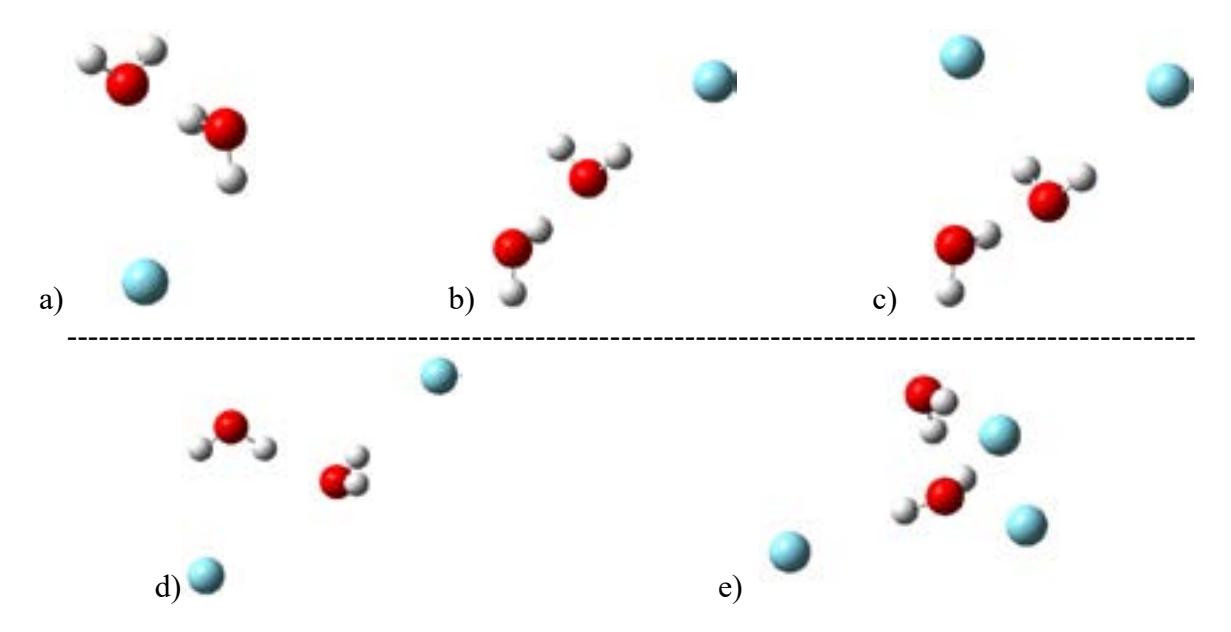
According to calculated data, single Ar atom does not effect the geometric parameters of the water dimer. But addition of the next one Ar atom leads to decreasing of the hydrogen bridge length. This tendency is more clearly seen in case of the appearance of three argon atoms near the water dimer. Results of the calculations in frame of PCM one can consider like limit when number of the Ar atoms became very large. In this limit the length of the hydrogen bridge is decreased by 0.005 Å. Tendency of the hydrogen bond strengthening is also confirmed by decreasing of the frequency of stretching donor O-H vibrations with increasing number of argon atoms.