Three-dimensional laser lithography (3DLL), based on multiphoton absorption in the polymer precursor volume, enables the formation of three-dimensional polymeric microstructures with high spatial resolution and accuracy out of various polymeric materials [1,2]. It has been demonstrated that structures fabricated by 3DLL undergo reversible deformations – shrinking or swelling – in different solvents [3]. Also, the type and degree of deformations differs depending on the polymeric material that is used [4]. By employing these unique features as well as, the possibility to fabricate different parts of the same object out of different polymer precursors, an opportunity for novel bipolymeric microstructures suitable for various applications arises.
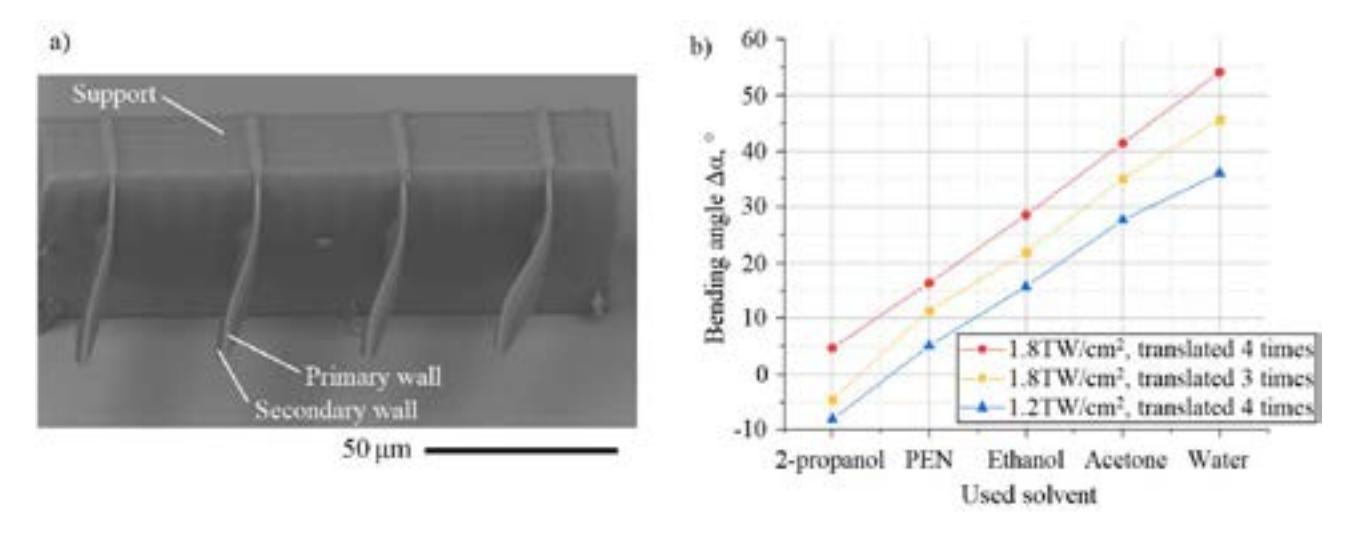
During this experimental work, two polymeric substances were used for bipolymeric microstructure fabrication: hybrid organic-inorganic SZ2080 and hydrogel PEG-DA-575 (Fig. 1 a)). Structures were exposed to five different solvents and their behavior was monitored. To determine the magnitude of the bipolymeric wall deformations, the angle of bending $\Delta\alpha$ was calculated for every solvent each time the structure was submerged in it.
We show that the angle of bipolymeric wall bending depends on the solvent to which the structure is exposed. Changing the formation parameters also changes the size of this angle and the amplitude of the deformation (Fig. 1 b)). Bending in these structures results from the fact that different materials either swell or shrink to a different degree in the same solvent. The change of 3DLL formation parameters also changes the force of interaction between walls made of different polymer precursors, therefore impacting the angle of bending. The maximum amplitude of the bend angle is 50 degrees (water – 2-propanol). It has been observed that the amount of bends does not have a significant effect on the properties of bipolymeric microstructures: during the cycles of substitution of different liquids in the same solvents, the change in the size of the bend angle varies within 3 degrees. Because of these features it would be possible to use such bipolymeric elements for various microfluidic applications. We suggest that it would be feasible to integrate these structures into microchannels and use them as valves that would open or close depending on the solvent that is passing through.