High-energy proton-proton collisions, performed using the Large Hadron Collider (LHC) at CERN, help us to look into the smallest building blocks of the Universe and search for the answers to yet unanswered questions. The proton-proton collision rate is getting increased every year in order to register more of the very rarely occurring events. This is challenging for scientists who have to decide where to store the data and how to reduce the time of the analysis.
Interactions between proton constituents, named "partons" (quarks and gluons), are happening during the high-energy proton-proton collisions. The probabilities of parton-parton interactions depend on the parton distribution functions (PDFs), which describe the inner structure of the proton. The precise knowledge of PDFs is required when calculating the probabilities of very rare events.
The Drell-Yan process is a quark-antiquark annihilation resulting in a lepton-antilepton pair. High-precision measurements of the differential Drell-Yan cross section are useful for constraining the PDFs, as well as for testing the perturbative framework of the Standard Model [1]. They are also important for many other experimental measurements, for example, the Higgs boson measurement, where the Drell-Yan process is a significant background [2].
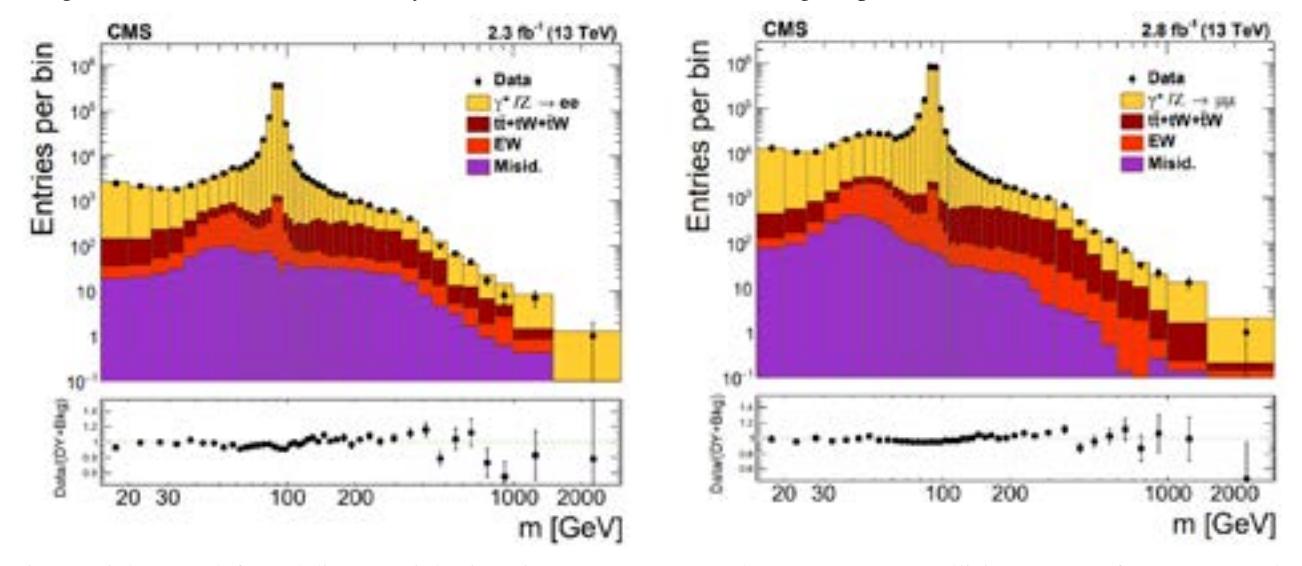
The measurements of the differential Drell-Yan cross section are carried out at various pp center-of-mass energies (7, 8, and 13 TeV) by ATLAS and CMS collaborations [1, 3, 4, 5, 6]. The CMS measurement with the 2015 data is submitted for publication [arxiv:1812.10529]. In 2016, the CMS experiment has registered more then 10 times the number of proton-proton collisions, registered in 2015. This helps to achieve higher measurement precision, but makes the time of the analysis a lot longer. In order to reduce the time of the analysis, additional event pre-selection can be made to create new data files containing only significant events for the further analysis procedures.
Some measurement uncertainties are related to simulation of distinct background processes. They can be reduced by estimating the number of background events using data-driven techniques. The number of background events in the signal region is determined from the observed yield in the background-dominated control region. Background processes which can independently produce different or same type of leptons are estimated using the $e\mu$ method. The event selection, background estimation and uncertainty calculation will be discussed during the presentation.