
Terahertz (THz) frequency range electromagnetic waves interaction with matter is a significant research field in the presence. It is possible to study weak bond oscillators, such as electromagnetic charge dipoles or molecular bonds, with characteristic time in picosecond range due to the low THz photon energy [1]. On the other hand, THz waves do not interact with strong bond oscillators, therefore materials, such as plastic, paper and textile, are transparent to THz radiation. It allows the THz imaging through such opaque materials and perform the spectroscopy of covered and sealed objects and substances. For the THz technology application the more compact, more efficient and cheaper THz emitters are desirible [2, 3]. THz spectral range is between radio waves and infrared radiation, therefore THz generation is a chalanging task. For optoelectronic methods THz photon energy is rather low and for radio-electronic methods THz frequency is rather high. There are several physics phenomena which can be exploited for THz emission. In this work, the responce of GaAs/AlGaAs parabolic quantum well (PQW) nanostructures to THz radiation is studied.
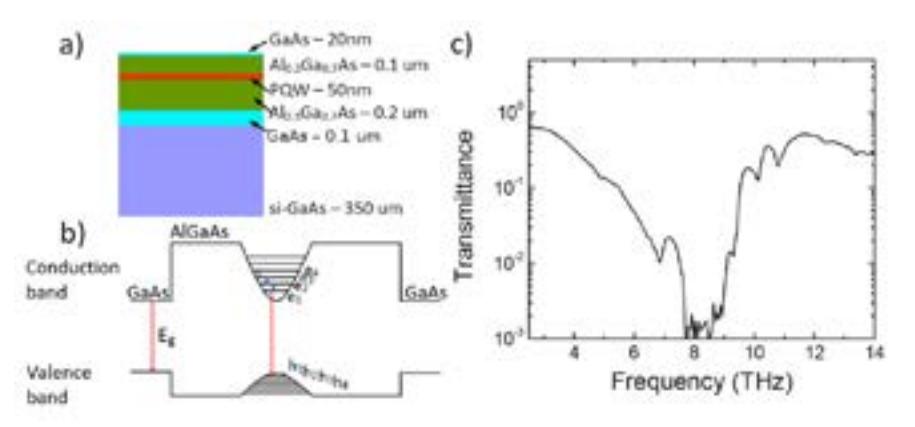
Samples were grown using molecular beam epitaxy technique. The schema of deposited layers stack and the corresponding energy band diagram of one of the samples are shown in the Fig. 1 a) and b), respectively. Sample consists of 350 μm thick si-GaAs substrate, 100 nm thick GaAs buffer layer, 200 nm thick Al0.3Ga0.7As, 50 nm thick PQW layer followed by 100 nm thick Al0.3Ga0.7As and 20 nm thick GaAs capping layer. The PQW was designed for equidistant energy subbands structure to meet the difference between the subbands of 29 meV what correspnds to 7 THz frequency.
Fuorier transform spectroscopy (FTS) in the THz frequency range was used to measure transmittance spectra of the sample. The FTS set-up was based on Michelson interferometer which consisted of a 6 μm thick HDPE beam spilter and two mirrors. One of the mirrors was fixed and the other was moved back and forth for the collimated beam modulation. The beam was generated by the Hg arc lamp, modulated by the optical chopper, transmitted through the FTS set-up as well as the sample and registered by the Golay cell. The experimental conditions allowed to reach the spectral resolution better than 60 GHz. The sample was attached to the cold finger of liquid-nitrogen-cooled cryostat allowing to stabilize the temperature of the sample at 84 K. The measurements were carried out in 0.23 mbar vacuum environment.
Prior to FTS experiment the low temperature photoluminescence (PL) spectroscopy at 3 K temperature was carried out for the sample containing PQW. It showed that the structure of energy subbands in the PQW is nearly the designed one. THz range transmittance spectra shown in Fig. 1 c) revealed the reststrahlen band of GaAs between 7.6 THz and 9 THz and AlAs transverse optical phonon spectral line at 10.86 THz frequency. Detailed analysis of transmittance spectra around 7 THz of the samples with GaAs/AlGaAs PQW nanostructures by comparison with the GaAs/AlGaAs epitaxial layers have not showed explicit differences. It is expected that the use of additional excitation source to populate the PQW subbands with carriers can lead to the noticable spectral responce to the THz radiation around the 7 THz frequency.