
With glass cutting technology advancing each decade, the laser industry is in search of efficient ways to dice glass. Bessel-Gaussian beam, due to its non-diffractive and self-healing properties, gained a particular interest in laser micromachining and, especially, in processing of transparent materials. A conical lens is the most efficient way to generate such beams, however, due to inaccuracies during fabrication, these optical elements often deviates from an ideal shape. It was recently shown that the oblate-tip axicon with an elliptical cross-section generates asymmetrical intensity pattern which induce asymmetrical modifications in glass [1]. These modifications locally weaken the sample and assure the sample separation along the cutting path, when cracks are aligned parallel [2]. It was also shown that the orientation of transverse cracks can be controlled by axicon tilt operation [3]. In this report we have investigated the Bessel-Gaussian beams, generated by axicons, which were fabricated by all laser-based technology [4], and applied for glass cutting.
The axicons with an apex angle of 170 deg were investigated. Experiments were conducted by use of the Atlantic HE (from Ekspla) sub-nanosecond laser, which generated 300 ps pulses of 2 mJ energy at 1 kHz repetition rate. The modified soda-lime glass sheets with the thickness of 1 mm were mechanically separated by use of the 4 point bending setup with a dynamometer, which enabled to measure the flexural strength of the material. Samples were locally weakened by single-shot modifications using non-tilted and tilted axicon-generated Bessel-Gaussian beams.
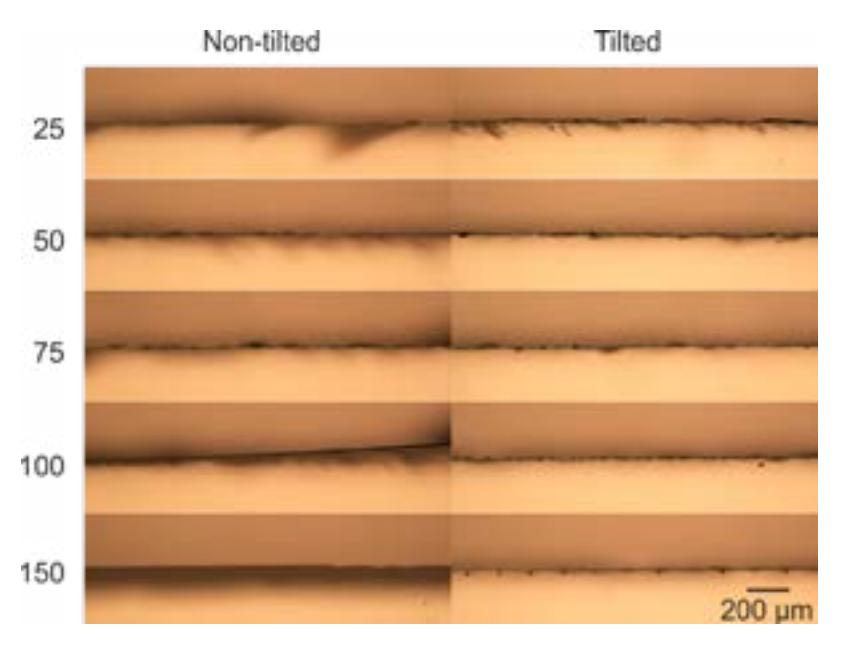
The axicon tilt operation allowed to induce the directional transverse cracks in the bulk of glass, while non-tilted axicon-generated beam induced randomly orientated cracks. The optical microscope images of the diced and separated glass sheets are presented in Fig. 1. Although in both cases it was possible to dice and separate glass sheets, the tilt operation allowed to achieve higher dicing speeds, lower flexural strength and better cutting quality.