Metal-organic frameworks (MOFs) are hybrid coordination polymers with an open pore system [1]. These coordination networks are formed from the various organic linker molecules and metal centers. The application areas of these highly porous compounds range from the biology to gas storage and separation [2,3]. The pore system in some of MOFs is already occupied by the guest molecules. The most popular class of such dense MOFs is metal-formate frameworks, which exhibit interesting ferroelectric and ferromagnetic (multiferroic) properties [4].
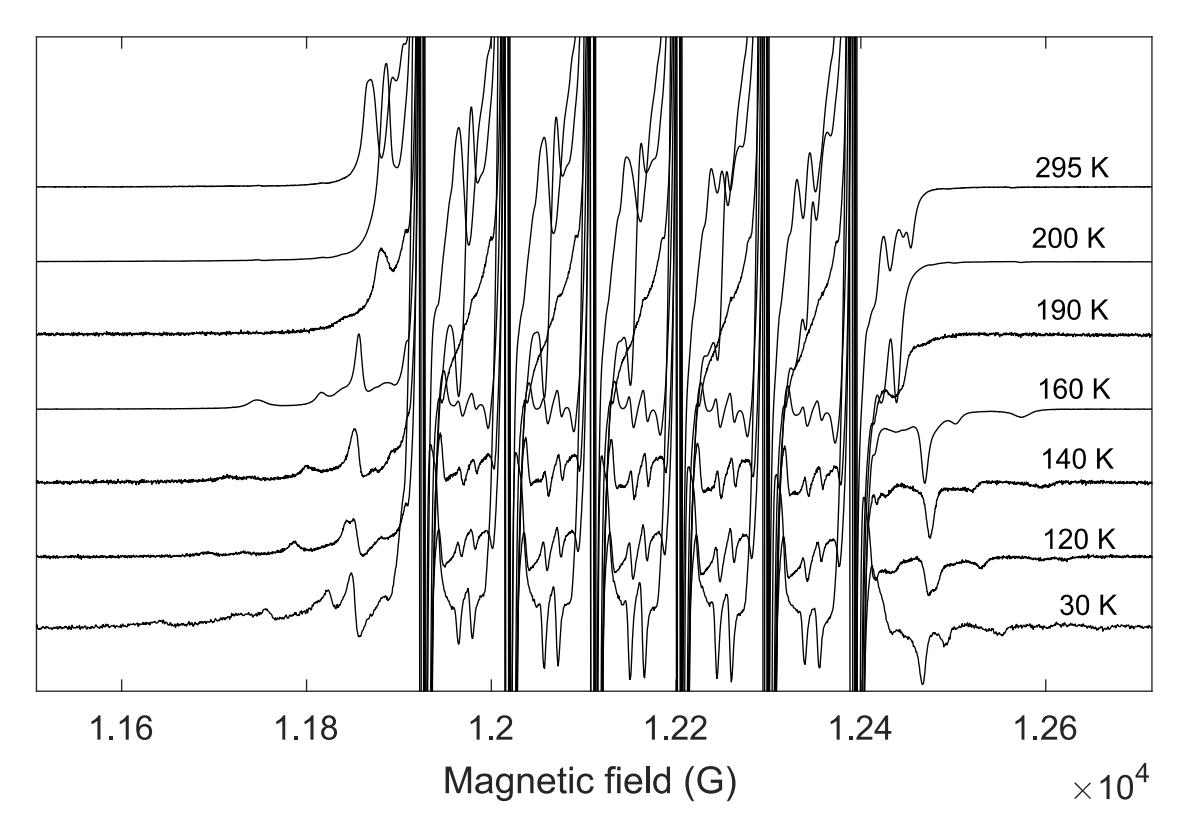
In this work, we present X- and Q-band continuous wave (CW) EPR study of [NH4][Zn(HCOO)3] framework doped with a tiny amount of paramagnetic Mn2+ ions. Extremely low concentration of these probe ions (0.1 mol%) allows us to resolve hyperfine and fine structure in the CW EPR spectrum. The latter interaction proved to be susceptible to the ferroelectric phase transition in [NH4][Zn(HCOO)3] framework. From the CW EPR spectra obtained at different temperature (Fig. 1), we observed structural order-disorder phase transition to the ferroelectric phase at 190 K related to the NH4 cation ordering and zinc-formate framework deformation.
Fig. 1. Temperature dependence of the Q-band CW EPR spectra of Mn2+ doped [NH4][Zn(HCOO)3].
[1] Coordination Polymers and Metal Organic Frameworks: Terminology and Nomenclature Guidelines (IUPAC, 2010, January-February, 23).
[3] Youn-Sang Bae, Omar K. Farha, Alexander M. Spokoyny, et al., Carborane-based metal-organic frameworks as highly selective sorbents for CO2 over methane, Chem. Commun.35, 4135–4137 (2008).
[4] Prashant Jain, Vasanth Ramachandran, Ronald J. Clark et al., Multiferroic Behavior Associated with an Order-Disorder Hydrogen Bonding transition in metal-organic Frameworks (MOFs) with the Perovskite ABX3 Architecture, J. Am. Chem. Soc.131, 13625–13627 (2009).