
Laser induced damage of optical components is one of the factor slowing down the development of laser technologies. As lasers' pulse peak power and radiation frequency grows, optical elements execute more functions, determining not only their laser induced damage threshold (LIDT), but understanding the whole mechanism that causes the damage would allow to seek even higher achievements in laser technologies. In this investigation, ultrafast spectroscopy methods are used to observe and analyze damage and aging processes of borosilicate glass bulk and titanium dioxide (TiO2) dielectric coating.
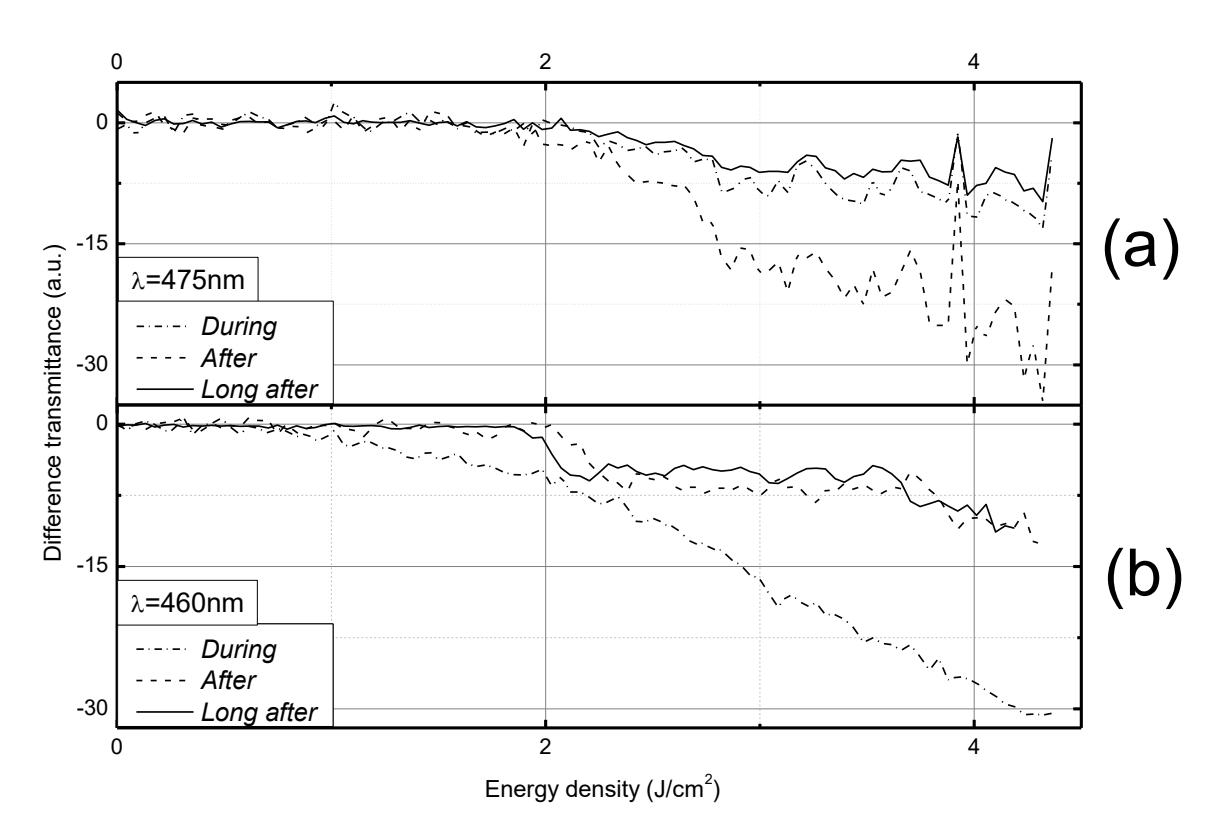
Measurements of both transparent media bulk and dielectric coating were made using a "single-shot” method where one pump pulse shots to one sample point at which the difference transmittance spectra is being detected. Exclusion of a single pulse and moving of the sample is necessary because the object might get damaged after the first pulse. The absorption spectra is measured at the same moment (During), 1ms after (After) and from 1ms to 1s after (Long after) the pump pulse - this allows us to track the kinetics of induced damage in the sample.
The main results of borosilicate glass (thickness 0.17mm) bulk and titanium dioxide coating are show in Fig 1(a) and (b), respectively. Difference transmittance dependence on pump pulse energy density shows LIDT of both samples (~1.91J/cm2 for glass and ~2.20J/cm2 for coating) and the difference between damage observation points in time, which shows the versatility of used measuring technique and the advantage over usual LIDT testing methods.
The whole laser induced damage measuring system was assembled and tested with these primary measurements. As now we can record difference transmittance and absorption spectra in femtosecond resolution, more measurements are going to be made to inspect various materials and dielectric coatings for their LIDT and to determine damage mechanisms. Observing spectral similarities between different materials and coatings will help to understand the physical properties of the damage itself and to offer solutions how the damage can be controlled.