
Fast inorganic crystalline scintillators are on increasing demand for medical imaging and detectors for high energy physics experiments. Bismuth germanate (BGO) is one of the most extensively used oxide scintillation crystals. Self-activated BGO scintillator is already exploited in positron emission tomography (PET). For a long time, the main scintillator characteristics have been the light yield, radiation hardness, and luminescence decay time. Now, there is an increasing demand for fast scintillator detectors to be used in high-luminosity experiments at particle accelerators and for medical imaging applications with improved spatial resolution.
To have an insight into the processes limiting the luminescence response time of BGO scintillators in general and to reveal the capabilities of BGO doping to influence the emission properties, we investigated BGO (Bi4Ge3O12) scintillation crystals doped with different ions: by 600 ppm Ca (BGO:Ca), 600 ppm Mg (BGO:Mg), 600 ppm Ti (BGO:Ti), 600 ppm La and Y (BGO:La,Y). Undoped BGO crystal was also investigated for reference. The samples under study with dimensions 1x1x0.2 cm2 were grown by the Czochralski technique at the Nikolaev Institute of Inorganic Chemistry, Siberian Branch of Academy of Science.
The light emission properties of the samples under study were investigated by measuring their photoluminescence (PL) spectra at different excitation intensities and temperatures. The measurements were performed using luminescence spectroscopy under excitation by nanosecond pulses, which were substantially shorter than the free carrier lifetime in BGO. The PL spectra were recorded using a double monochromator (HRD-1) coupled with a photomultiplier tube (Hamamatsu R1463P). Tunable-wavelength laser (Ekspla NT34B) emitting at 257 nm (4.824 eV), having a pulse duration of 4 ns and a repetition rate of 10 Hz was exploited for excitation. The excitation beam was focused on the sample surface into a spot of ~600 μm in diameter. The measurements were performed in a wide temperature range from 10 to 300 K and under excitation intensities ranging from 0.012 MW/cm2 to 3.64 MW/cm2.
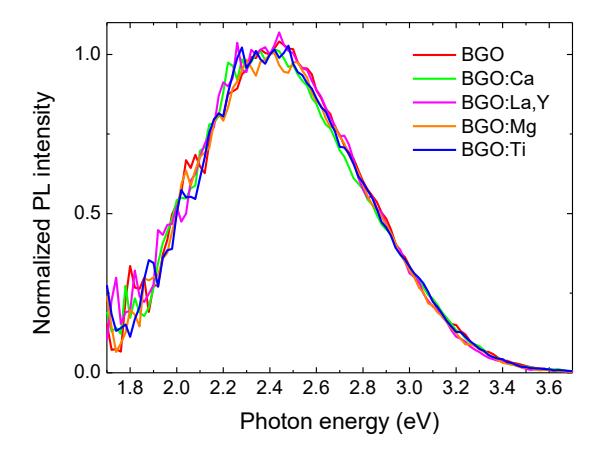
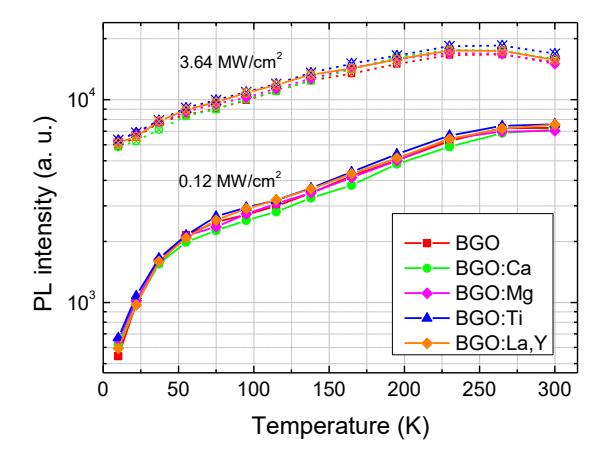
It was observed that the absorption edge of BGO does not depend on doping with Mg, Ti, La, Y, while an additional absorption band at 312 nm is introduced by doping with Ca. As seen in Fig. 1, where the PL spectra of all the samples under study are presented, doping of BGO crystals has no influence on the form and intensity of photoluminescence spectra. No changes in the shape of PL band were observed when excitation power density was varied. Meanwhile, the PL bands in all samples under investigation become broader with increasing temperature. We also observed sub-linear dependence of PL intensity on excitation intensity tending to saturation at elevated excitation intensities. This process is more pronounced at higher temperatures. The origin of the dependence is discussed. Our results show that the PL intensity increases with the temperature increase (Fig. 2). The increase is stronger at lower excitation intensities. This behavior is explained by thermally activated carrier transfer to radiative centers.