
Solid-state lighting recently has become one of the main light sources. While light-emitting diodes are used in many different fields of illumination, they suffer efficiency droop effect. Droop-free laser diodes based white lighting starts to be used in specific cases where lighting of high directionality and power density is desired [1]. In these luminaries blue laser diode is coupled with yellow phosphor to gain white light. Phosphor powder is dispersed in matrix, which is heating due to high laser diode power density. High temperatures cause photoluminescence thermal quenching and degradation of matrices. In order to reduce temperature of phosphor, matrix must have good thermal properties. This problem usually is solved using phosphor in glass, phosphor ceramics and monocrystalline phosphors [2, 3, 4]. Here we present simple and commercially attractive method to increase thermal conductivity of phosphors with polymer matrices. In this work organic matrices used in commercial luminaries are presented with additionally added high thermal conductivity material.
Firstly, samples with three different fillers and three different holding matrices and phosphor were made and their thermal conductivity and photoluminecsence properties were measured. Composite with most suitable properties was chosen for following experiments. In the second part of experiment samples with yellow and green phosphors, one of the holding matrices and different concentrations of high conductivity powder were prepared. Relative thermal conductivity, photoluminescence decay time, intensity and quantum yield of samples were measured. In addition, samples temperature and photoluminescence intensity dependencies on incident excitation power density were evaluated.
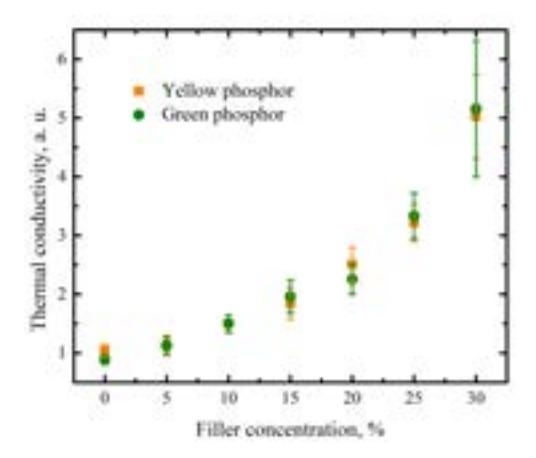
It was found out, that investigated composite is suitable for holding matrices of phosphors. The introduction of high thermal conductivity filler in holding matrices increase thermal conductivity of samples few times (Fig. 1), does not absorb photoluminescence excitation or emission radiation and does not diminish quantum yield. Inclusion of fillers results in higher reflection of excitation radiation but on the other hand helps to decrease losses based on photoluminescence thermal quenching. Therefore, it is important to find optimal concentration of high thermal conductivity powder to reach maximum photoluminescence intensity.