
Sosnowsky's hogweed (Heracleum sosnowskyi Manden.) is invasive plant entered into list of Invasive Alien Species of Union concern [1]. It is highly toxic plant to humans and well established in seven EU countries where transforms the landscape. Sosnowsky's hogweed propagates only by dry-fruits i.e. seeds and produce them once in lifetime. Well known the important role of gibberellins and auxins on seed development of fleshy fruits [2,3]. To figure out the role of gibberellic acid (GA3) in dry-fruit i.e. seed development, we applied Sosnowsky's hogweed's unpollinated ovaries in satellite and stem branch umbels by different concentrations (0.07 mM, 0.14 mM, 0.28 mM, 0.43 mM) of exogenous GA3. GA3 treatment didn't have a significant effect on size of H. sosnowskyi seeds, however it caused changes in shape. Longitudinal sections of mericarps and SEM micrographs of embryos revealed that embryos after GA3 (0.43 mM) treatment were at torpedo stage, whilst mature embryos in control seeds had been observed (Fig. 1).
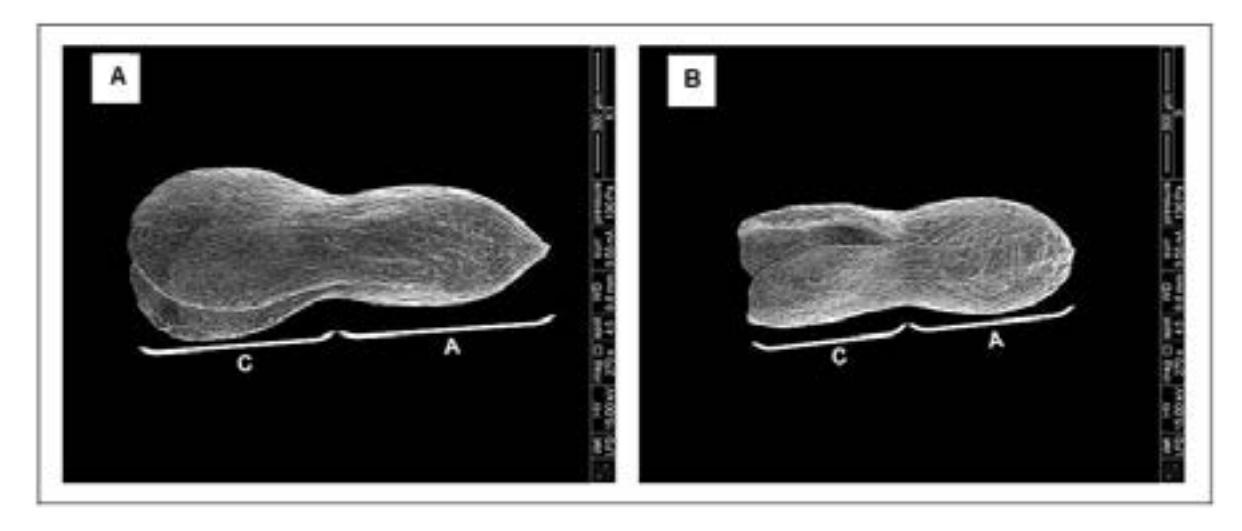
Furthermore, we disclosed that GA3 treatment significantly reduced the germination rate in situ conditions of H. sosnowskyi mericarps from 98.0% to 16.5% in control and GA3 (0.43 mM) treatments respectively. Auxin transport inhibitor (1,3,5-triiodobenzoic acid, TIBA) was used to affect auxin and gibberellin crosstalk in fruit development. [3]. Inhibition of auxin transport from the apical shoot by TIBA decreased seed germination rate in field conditions (98.1% and 29.8%; control and TIBA), the auxin effect on seeds' sufficient development was negated by indoleacetic acid (IAA) application on unpollinated ovaries right after the TIBA treatment (germination rate 96.1%). All these results suggest that exogenous GA3 application has influence on dry Sosnowsky's hogweed seeds development and affects germination rate. Thus, it could be assumed that GA3 could be used to inhibit the spread of this invasive plant.