
Passive metal-dielectric multilayer metamaterials have been investigated by the researchers for many years. It has been shown that such structures can be used for imaging with sub-wavelength resolution, efficient light absorption, subwavelength focusing, switching, sensing, as well as spatial or temporal frequency filtering [1-3]. Here, we want to go one step further. We report on numerical modelling of light propagation in electrically tuned multilayer hyperbolic metamaterial. The considered heterostructure consists out of subsequent metal-oxide-semiconductor thin films (see Fig. 1a). As active material we use indium-tin-oxide, a highly doped n-type semiconductor with high electrical conductivity and transparency in the visible spectral range. As it was demonstrated earlier it is possible to control the carrier concentrations and thus the refractive index at the dielectric/semiconductor interface by applied external electric field [4]. We exploit this mechanism in order to tune the optical response of the hyperbolic metamaterial structure.
Two different techniques were used in order to model light propagation in studied multilayered systems. The first one is a Transfer Matrix Method (TMM), a very computationally efficient algorithm, which allows to calculate transmission refection, and absorption of planar waves through/from and in 1D multilayer stack. The second technique is a finite-difference time-domain method (FDTD), which is a fully vectorial algorithm for solving the Maxwell's equations in electrodynamic problems. We use it for calculating imaging performance of the heterostructure. To estimate the isofrequency contours associated with the metamaterial, and thus to verify dispersion operation regimes we use the effective medium theory.
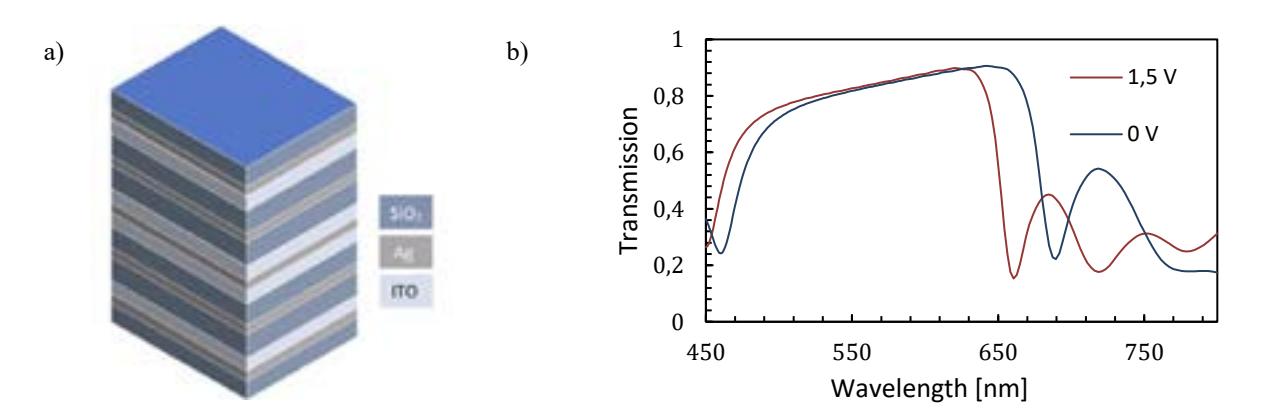
In Fig. 1b we show one of the effects resulting from the impact of the applied voltage on the optical properties of optimised multilayer metamaterial. Without external field the structure has a broad transmission window ranging from 470 nm up to 670 nm with transmissivity reaching 85% for 650 nm. When the voltage is applied the increased carrier concentrations at the SiO2/ITO interfaces leads to a significant shift in the transmission window. We believe that this effect can be utilized in ultrafast modulation or spectral filtration of metamaterial-based devices of the future.