Optical three-dimensional printing (O3DP) has emerged as an additive manufacturing technology out of photosensitive materials employing light [1]. Light induced photopolymerization reaction is the key process to make liquid resin to solid objects. Most materials absorb ultraviolet (UV) or deep-UV light, thus relevant light sources common in scientific laboratories must be used. To operate in visible (VIS) light range, photoinitiators (PI) must be added [2]. On the other hand, PI are undesired because of their toxic properties. An approach enabling to avoid both of limitations, UV light and PI, is a two-photon polymerization (2PP) technique. 2PP is based on non-linear absorption, occurring due to high irradiation intensities within a confined small volume. It can be achieved with tightly focused ultrashort pulsed laser beam. Positioning the focused beam through the material it is possible to create various 3D objects in mesoscale with up to 100 nm spatial resolution [3]. This technology is a branch of so called direct laser writing (DLW) 3D lithography.
O3DP and DLW are based on light-matter interaction, which induces photoreaction in monomers, crosslinking them into polymers. Although technologies are implemented differently, a proper material selection remains a common task for both techniques. Most of the photosensitive resins are petroleum-derived even though alternative materials obtained from renewable resources can be used instead [4]. In the recent decade interest in plant-derived products has increased dramatically [5].
In this work we examine an acrylated epoxidized soybean oil (AESO), which is attractive due to the high amount of various functional groups such as the acrylic, epoxy and hydroxy groups. The aim of the work was to investigate if AESO as a plant-based renewable resin can be suitable for both technologies: O3DP, employing non-laser UV and visible light (385 nm and 405 nm wavelengths) digital light processing (DLP), and DLW using 515 nm wavelength (fundamental 1030 nm), 300 fs pulsed laser irradiation with high pulse repetition rate (200 kHz). There were used three different photoinitiators (BAPO, TPO and TPO-L) to absorb aforementioned irradiation and induce efficient radical photopolymerization. Three diluents (n-butanol, ethyl-lactate, Genomer 1122) were applied to dilute PI and reduce monomers viscosity. In DLP case, penetration depth $h_a$ to the resin and critical duration $T_c$, required to reach critical does to fully polymerize the resin, were assessed using Beer-Lamber law. In DLW case, irradiation power P, beam scanning velocity v and distance between adjacent beam scans $d_{xy}$ were modified. It allowed finding the fabrication window in the AESO based resins.
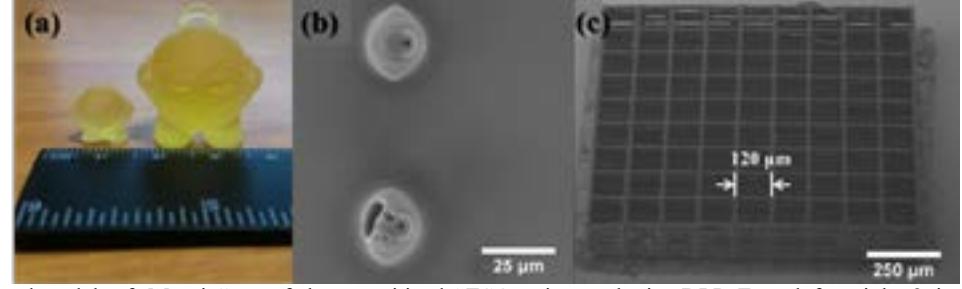
In this research it was shown, that AESO monomers can be selectively polymerized employing 385 nm and 405 nm wavelengths light. Measured $h_a$ and $T_c$ were: 260 μm and 0.4 s for the 385 nm light; 400 μm and 0.8 s for the 405 nm light. O3DP was demonstrated using DLP (Fig. 1 (a)). It was assessed, that pure AESO monomers can be photostructurized employing DLW (Fig. 1 (b) and (c)). Evaluated fabrication parameters were: P=0.6-0.8 mW (2-2.7 TW/cm2), when v=2.5-5 mm/s and P=0.9-1.2 mW (3-4 TW/cm2), when v=5-10 mm/s. In both cases it is appropriate to set $d_{xy}$ between 0.25 μm and 1 μm.
In this paper photostructuring of AESO monomers was demonstrated at mesoscale – merging macro- and micro-objects. Evaluated parameters showed great perspectives for versatile applications of AESO in O3DP and DLW technologies [6] as a resin derived from natural resources.