Electric-spark alloying (ESA) is a process by which it is possible to achieve hard alloy coatings on the surface of a workpiece by transferring small portions of material from anode to cathode when plasma discharges occur. ESA is an economically advantageous process that is capable of widely changing mechanical, electrical, thermal and other properties of the workpiece depending on the selected alloying material, processing environment, pulse characteristics, electrode shape and type of tool electrode (TE).
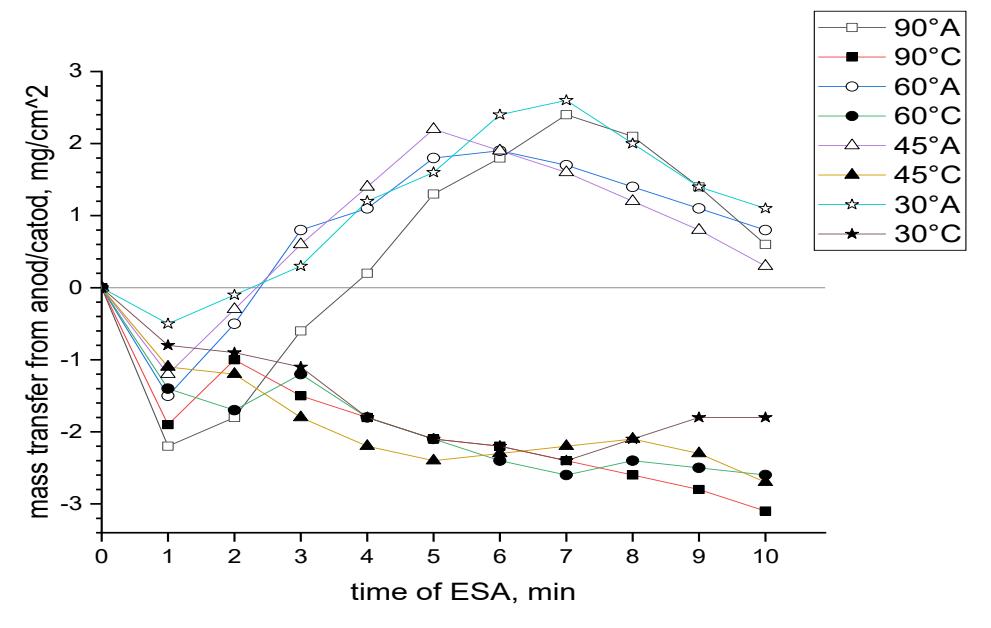
One of the important indicators of ESA process is the transfer of material from electrode to the substrate, evaluation of the material transfer from anode to cathode is change in mass after ESA occurs. In this work we analyze changes in mass of a cylindrical shape billet of titanium alloy (GOST VT1-0) after applying on a surface hard alloy of T15K6, using two types of TE (vibrating, rotating). According to previously published papers related to the mass transfer problem between anode and cathode, it was established a relationship at which the cathode weight gain is clearly visible depending of the TE type on a flat stationary part [1]. Also, one of the problems of alloying titanium is that at the beginning of the process there is an erosion of the material occurs which disappears with increasing surface treatment time [2,3]. At the same time, the issue of applying hard alloys on rotating bodies made of titanium has not yet been reflected in scientific papers. This work was performed on the installation “TOPAZ-ESA” a lathe-like ESA machine with a system for holding the average current between the electrode and the workpiece by adjusting the interelectrode gap, when performing the work, different rotation modes of chuck with workpiece were considered, the angle at which the TE touches the workpiece as well as the speed of rotation of TE an vibrating amplitude for vibrating TE. Titanium workpiece was processed using pulse modes from 25 to 200μs with a frequency of 100,200,300 Hz.