Graphene is 2D nanostructure consisting of one or few graphitic layers. In plane each carbon atom is bound to three neighbors by sp2 hybridized σ bonds, while fourth electron orbital is normal to the structure and is delocalized. Graphene exhibits exceptional electronic (charge mobility up to 2.5·105 cm2V-1s-1)[1], mechanical (Young's modulus ~ 1 TPa)[2], optical (transmittance more than 95 %)[3] and thermal (thermal conductivity ~ 5000 Wm-1K-1)[4] properties. Such combination of physical properties would improve characteristics of various semiconductor devices, such as touch screens, photodetectors, transistors, bendable electronics and more[5]. However, mentioned exceptional physical properties are only exhibited in highly ordered, contamination and defect free graphene. This is only achievable using mechanical exfoliation of highly ordered pyrolytic graphite (HOPG), while synthesis steps include complicated and time-consuming substrate-to substrate transferring. Graphene contamination and wrinkles formation problems arise. Therefore, direct synthesis of graphene on silicon substrate is favorable. One way of achieving this by chemical vapor deposition (CVD). In this case, growth mechanism involves dissociation of carbon precursor at high temperature on catalyst surface, carbon in catalyst (Cu, Ni, Co) and graphene precipitation at the surface of catalyst as sample cools down[6]. This relatively expensive process could be substituted by magnetron sputtered carbon-catalyst film annealing.
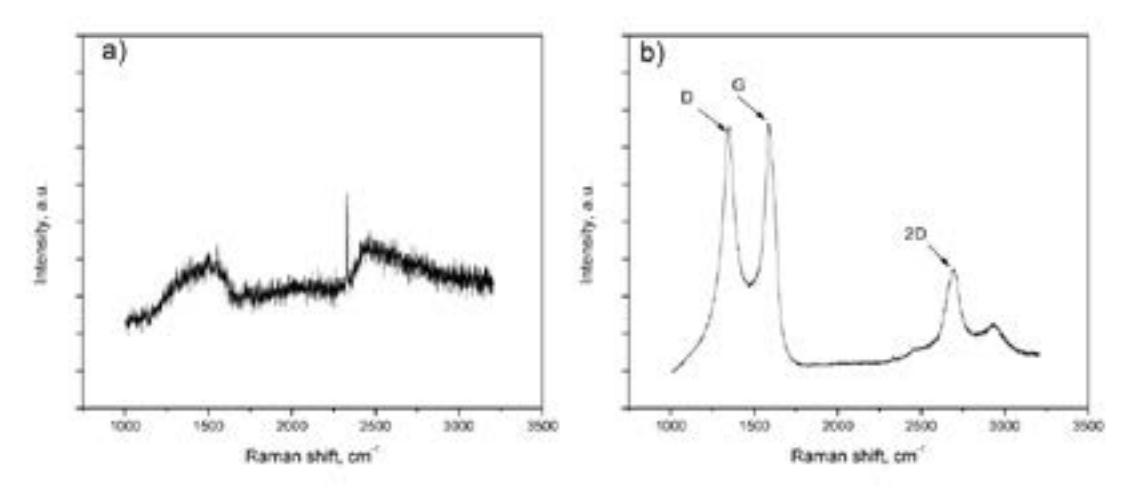
In present work, nickel and carbon composite films were deposited on monocrystalline silicon using direct current (DC) magnetron sputtering. Deposited films were annealed for 15 minutes at 800 °C in quartz cylinder using pulsed lamp. Argon gas was used to reduce oxidizing atmosphere. Films phase was investigated using Raman scattering spectroscopy (532 nm, inVia, Renishaw, UK). As seen from fig. 1. a) initial (before annealing) films did not exhibit sharp peaks, associated with carbon phase, which indicates that carbon was distributed in the bulk of the film. After annealing (fig. 1. b)) spectrum indicates characteristic carbon peaks typical for graphene: D peak (1346 cm-1), G peak (1588 cm-1) and 2D peak (2693 cm-1). Analysis of these peaks revealed formation on the surface of the nickel film of the defected few-layer graphene.