
Carbon nanotubes (CNTs) are thought can be perspective systems for delivery of therapeutical agents and destructing of tumor cells. Nevertheless, CNTs can influence negatively on normal cells of organism [1-3]. It was shown that cytotoxic effect of CNTs on cells is strongly depends on their length and diameter, physical and chemical surface properties, method of CNTs synthesis and contamination by catalysts [4-6]. The purpose of our study was to investigate the influence of carboxylated multiwalled CNTs (CMWCNTs) and covered by polyethylene glycol (PEG) CMWCNTs on properties of red blood cells (RBC).
RBC were isolated from blood of healthy donors by washing in 0.15 M NaCl and suspended in Earl's balanced saline solution (pH 7.3). CMWCNTs were mixed with PEG 400/4000 or 0.15 M NaCl in amount of 4 mg per 1 ml and sonicated at frequency of 44 kHz during 30 min. Then, CMWCNTs were added into RBC suspension samples up to the final concentrations of 0.001, 0.01 or 0.1 mg/ml and incubated at 37 °C for 20 h. After that, the cells were transferred to sediment by centrifugation and resuspended in fresh medium, and the obtained supernatants were collected to determine of hemoglobin release from RBC. The levels and type of hemoglobin in the samples of RBC extracellular medium were determined by analysis of absorption spectra at 380-700 nm. The sizes of RBC were estimated using light microscopy and nephelometry methods.
It has been revealed that under action of CMWCNTs the levels of free hemoglobin in RBC extracellular medium are decreased, particularly after addition of 0.1 mg/ml CMWCNTs (fig.1). PEG-treated CMWCNTs induce more significant changes of hemoglobin levels, but PEG without CMWCNTs is not influence on this parameter (fig.1). The decrease of free hemoglobin concentration is shown to be caused by sorption of hemoglobin molecules by CMWCNTs that it doesn't allow to characterize the RBC lysis or safety of the cells. The partial small transformation of oxy-form of hemoglobin to met-form has been detected.
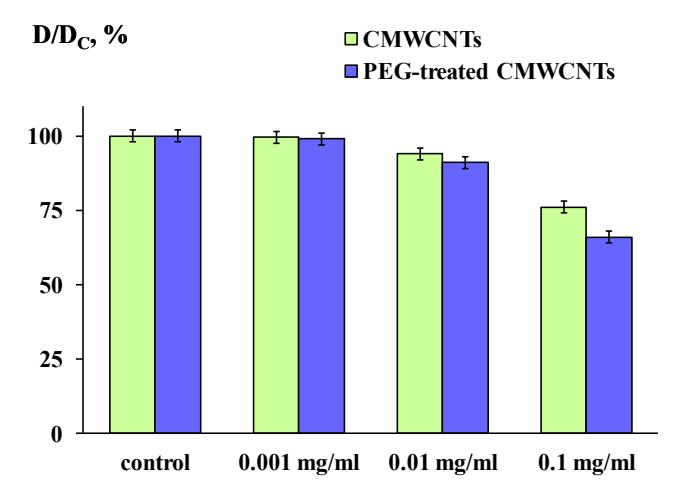
D and DC – optical density at 410 nm in experimental and control samples
In the result of RBC properties investigation by microscopy and light scattering (nephelometry) methods the modification of RBC is established. It has been obtained that diameter of the cells rises significantly, but the count of the cells is decreased after incubation of RBC in the presence of CMWCNTs and especially PEG-treated CMWCNTs.