
Among the active fields of research in nanosciences are nanoparticles and their properties. The Mie theory was the very first description of light interaction with a particle and it was extended for describing the interaction with highly focused beams. The polarization properties of highly focused electromagnetic beams strongly influence the size and shape of the focal spot of the beams. Analytical vectorial solutions of Maxwell's equations describing highly focused and variously polarized vector complex source vortex beams [1] are used to investigate interaction with nanoparticles. In recent publications, the interaction between such beams and nanoparticles has been investigated [2,3]. Creation of artificial structures, where chirality is controlled via shape and geometry, is enabled by modern micro- and nano-fabrication techniques. A similar optical behavior can result also from purely geometrical properties of a three-dimensional arrangement of nanoobjects without chirality, such as nanospheres
In this work, the so-called T-matrix and MSM (multiple scattering matrix) methods are used to calculate fields scattered from a chiral cluster of nanoparticles. The incoming fields are calculated from a scalar wave equation using the complex source beam (CSB). From a scalar solution we can derive vectorial solutions using classical technique, which is described in [4]. The electric field can be expressed in terms of multipole functions Eq. (1) as
$$ \mathbf{E}_{inc}(\mathbf{r}) = \sum_{n=1}^{\infty} \sum_{m=-n}^{n} A_{mn} \mathbf{M}_{mn}(\mathbf{r}) + B_{mn} \mathbf{N}_{mn}(\mathbf{r}).\tag{1} $$Here coefficients $A_{mn}$ and $B_{mn}$ describe the incident field, which is related to the scattered field via a T-matrix. The T-matrix depends on the geometry of the particles configuration [5], so the scattered field is
$$ E_{sca}=T\times E_{inc}\tag{2} $$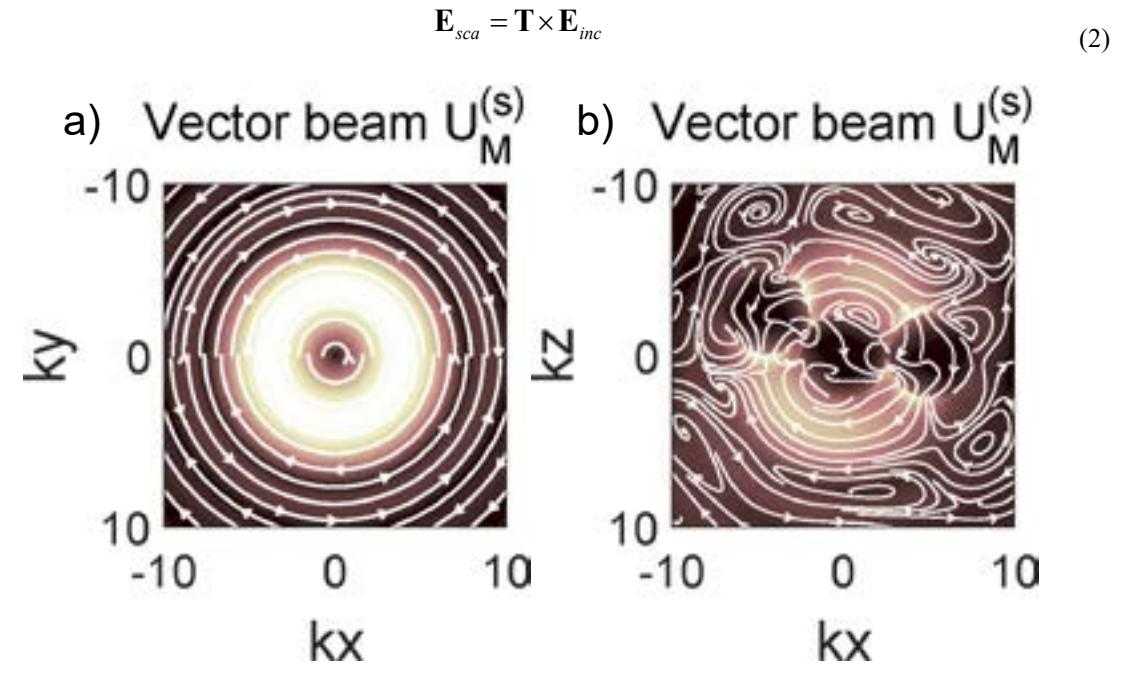
Furthermore, we investigate different polarization states of the incident beam and their interaction with nanoclusters, see Fig. 1.