
Amphiphilic molecules such as polar lipids self-aggregate in a variety of different morphological structures known as lipid liquid crystalline (LLC) phases. LLCs have been extensively investigated due to their possible applications in multiple fields such as drug delivery systems, biosensors, protein crystallization and immobilization, and model systems that mimic biomembranes. LLCs with an inverse bicontinuous cubic (Q) and sponge (L3) phases attract most of the attention due to their ability to entrap both hydrophobic and hydrophilic compounds. It can also form water pores that are large enough to accommodate macromolecules such as proteins [1]. While the inverse bicontinuous cubic phases are well studied, there is a lack of knowledge on the structure and molecular interactions of the sponge phase.
This study [2] was carried out using molecular-level sensitive Raman spectroscopy and small-angle X-ray scattering (SAXS) methods in order to understand structure, phase behavior and molecular interactions within self-assembled lipid structures. The evolution of self-assembly of diglycerolmonooleate (DGMO) and Capmul glycerolmonooleate (GMO-50) lipid mixture with surfactant Polysorbate 80 along the dilution line allowed us to follow curvature transformation from lamellar (Lα) to bicontinuous cubic and to the sponge LLC phases. Also, we inspected the temperature effect on LLCs curvature and related the changes observed by Raman spectroscopy to molecular interactions within the lipid bilayer.
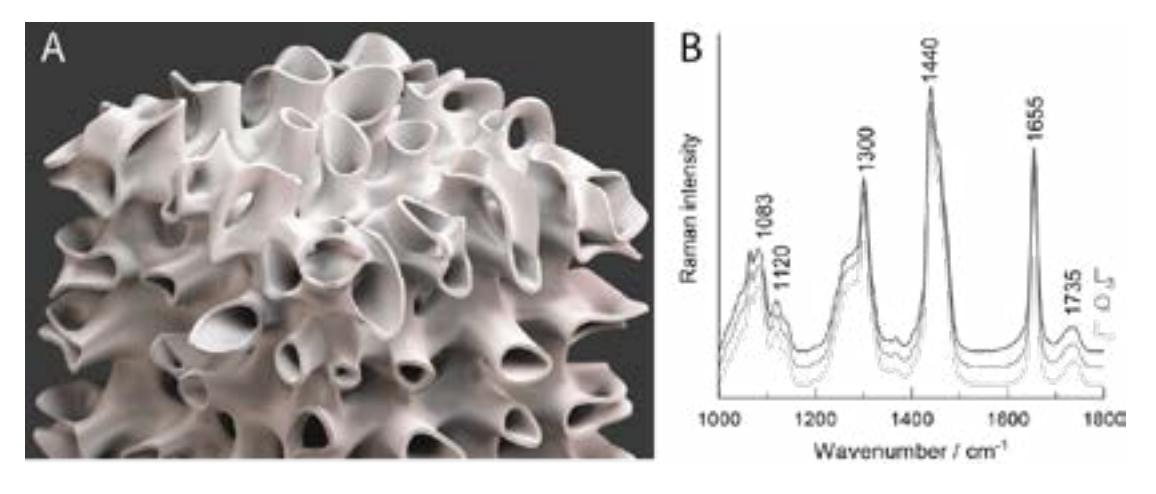
Raman data reveal only a minute changes between different LLC samples (figure 1B), which confirm that they are all composed of a lipid bilayer although with different curvature as indicated by SAXS. However, the difference spectra point to key spectroscopic markers, which appear to be faint, but nonetheless, give profound information. Our study demonstrates that the lamellar phase presents less fluid hydrocarbon chains compared to inverse bicontinuous Q and L3 phases. In addition, the disappearance of acyl-chain clusters of more ordered structures in the L3 phase was also observed. Raman scattering and SAXS data suggest, that increasing temperature induces the acyl chain motion and decoupling, which in turn favors the formation of structures with larger negative curvature and bigger water pores.
These findings support the fact that the sponge phase is structurally similar to the cubic and lamellar phases. However, it displays the highest bilayer flexibility and ability to uptake large amounts of water, which is essential for encapsulation of macromolecules.