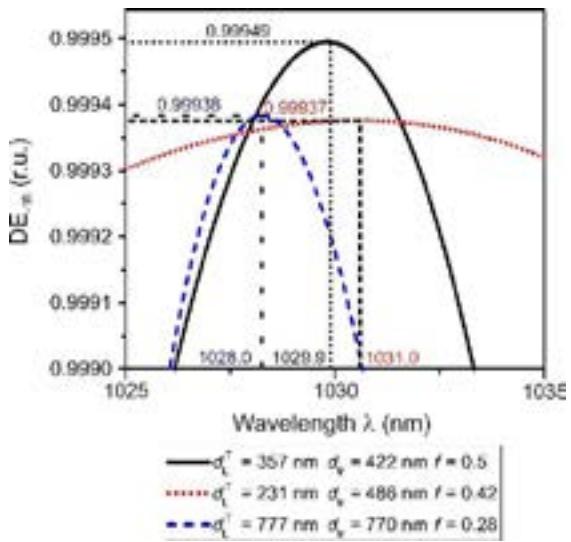
Component damage thresholds and optical losses of ultra-short pulse lasers are prime reasons of laser power cap. Development of diffraction gratings that are essential for chirped pulse amplification (CPA) systems are the main course for achieving exawatt (1018) peak powers [1]. Optical damage threshold above the used intensities, nearly 100% diffraction efficiencies (DE) for a broad spectral range of the ultra-short laser are the primary parameters characterizing high-diffraction efficiency periodic gratings [2]. Main optical loses of ultrashort pulse lasers occur because of the difficulty of achieving >99.9% diffraction efficiencies. A course for DE optimization using multilayer-dielectric diffraction gratings based on a 1064 nm laser line high reflectivity dielectric mirror was proposed. Simulations showed that DE of nearly 100% can be obtained by varying the thickness of the top low refractive index SiO2 layer ($d_{L}^{T}$) and the grating depth ($d_{tr}$). During these numerical simulations three different structures with >0.99 DE were found (see figure 1).