Infrared spectroscopy is a powerful tool widely used in research and industry for an identification of molecules. Its application to spectroscopic analysis of minute amounts of matter in sensing applications is hampered by the low infrared (IR) absorption cross-sections. Surface-enhanced infrared absorption (SEIRA) spectroscopy using resonant metal nanoantennas, or short resonant SEIRA, overcomes this limitation. SEIRA was found to be strongly dependent on the metal surface morphology that is the result of specific preparation conditions, such as substrate temperature, deposition rate, substrate material, and surface morphology [1]. In the present work, gold nanoparticles of different morphology have been synthesized and their impact was studied on IR absorption of 3-(adamantan-1-yl)-4-ethyl-1-[(4-phenyl-piperazine-1-yl)methyl]-1H-1,2,4-triazole-5(4H)-thione.
Infrared spectra (IR) were studied for 2 types of samples: the layer of molecules on the aluminum foil and that on the same foil with a layer of gold nanoparticles on top. IR spectra have been measured using a FT-IR spectrometer Nexus (Thermo Nicolet, USA) supplied with an IR microscope setup Continuum (Thermo Fisher Scientific, USA) with a 15x-objective.
Gold nanorods and nanospheres were synthesized by a seed-mediated growth method [2]. According to this procedure, at first, the seed solution was prepared by reduction of chloroauric acid (HAuCl4) with sodium borohydride in the presence of cetyltrimethylammonium bromide (CTAB) as a stabilizer. Next, the growth solution was separately prepared, in which Au3+ ions were reduced to Au+ ions by ascorbic acid in the presence of CTAB and silver nitrate to facilitate the nanorod formation. The nanoparticle size and shape were controlled by amount of seeds that were added to the growth solution and the concentration of ascorbic acid. The resulting nanoparticles were covered with a 3.2 nm thick CTAB bilayer [3]. The optical density spectrum of gold nanorods has two broad plasmon peaks at 532 and 750 nm. Gold nanospheres coated with citrate-ion were prepared via standard Turkevich method [4] by the reduction of HAuCl4 with sodium citrate at reflux. Citrate-ion played the role of both the stabilizer and the reducing agent. The optical density spectra of gold nanospheres stabilized with citrate-ion and CTAB have the plasmon peaks at 526 nm and 532 nm respectively.
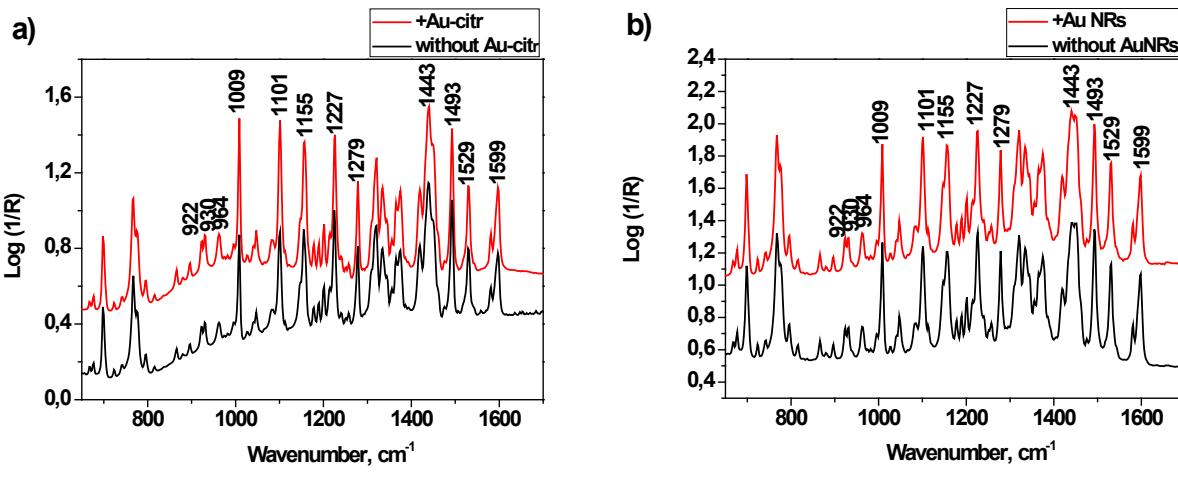
It was shown (Fig.1a) that in the presence of gold nanospheres, the IR absorption of the molecule is increased up to 1.5 times. The presence of gold nanorods does not significantly affect the IR absorption of the molecules (Fig. 1b). Gold nanospheres stabilized with citrate-ion showed greater enhancement than gold nanoparticles stabilized by CTAB. This may be due to the smaller thickness of the stabilizer shell.