Concern of environmental welfare lead to search of lead free piezoelectric materials in the last few decades. European Union released Restriction of Hazardous Substances directive which has limited the use of lead in certain fields. For the past 40-50 years, lead base perovskite Pb(ZrxTi1-x)O3 (PZT) piezoelectric ceramics have dominated the commercial market of piezoelectric devices due to their remarkable dielectric and piezoelectric properties and ability to operate in wide temperature range. Replacing PZT solid solutions is a difficult task, due to poor dielectric and piezoelectric properties of its replacement contenders (BT, KNN, BZT, NBT and etc). In our study we investigate dielectric properties of core-shell-like structure of barium tinate (shell) - bismuth ferrite (core) (BT-BF) and barium titanate (shell) - barium titanate (core) (BT-BT), with molar ratios of 1:3.
BT or BF nanoparticles and TiO2 were combined with the ball mill technology, afterwards organic binder poly was added. The mixture was compressed and dried at 600 °C ,for BT and 400 °C for BF temperature and kept under these conditions for 10 h. Later, disk-shape pellets were submerged into barium hydroxide solution at 175 °C temperature for solvothermal solidification. As the result we obtained core-shell like structure with BT or BF as a core and BT, obtained by solvothermal reaction, as a shell.
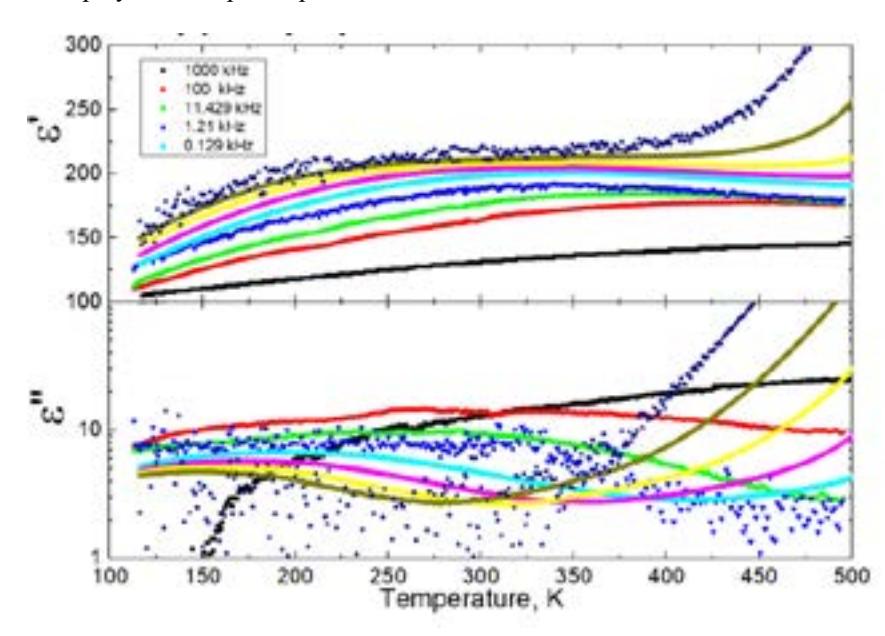
In this presentation we can see the results of BT-BF temperature dependence of dielectric permittivity. The first thing we notice is the absence of anomalies in BT-BF composite. We can notice the gradual increase of real permittivity with increase of temperature. Overall, we can see that BT - BF exhibited large values of dielectric permittivity. Other, more particular results will be displayed in the poster presentation.