
Plain jersey knitted fabrics and adhesive bonds are widely used in functional or leisure garments manufacture due to their excellent performance properties [1, 2]. The quality of adhesive bond depends on textile properties, on the technological parameters of bonding, on seam construction, etc. [3]. Thus, the aim of this research was to determine the influence of bonding duration on textile bonds peeling strength.
Investigation was performed with five commercially available knitted fabrics with a plain jersey knit type and one polyurethane (PU) adhesive film of 0.175 mm thickness (melting – 90-100°C temperature). The characteristics of the investigated materials are presented in Table 1. Bonds were laminated by applying PU adhesive film on pairs of lengthwise textile samples ensuring 8x50 mm2 bond areas using the pressing device GTK DEA 25R. Bond was created by heat at 5.6 kPa pressure in three stages: 1st – the PU film was carried onto the face side of knitted material sample at 110 °C temperature for 5 s; 2nd – silicon paper was peeled off from PU adhesive film in 5 min; 3rd – the other side of knitted material sample was laid on the sample with the PU film and was bonded at 140°C temperature for 10 s, 20 s, 30 s and 40 s.
| Material code | Fibre content | Course count | Wale count | Surface density, g/m2 | Thickness, mm |
|---|---|---|---|---|---|
| Ks2 | 84 % polyester, 16 % elastane | 21.0 ± 0.5 | 33.0 ± 0.5 | 218.8 ± 2.0 | 0.69 ± 0.02 |
| Ks3 | 90 % polyester, 10 % elastane | 14.0 ± 0.5 | 28.0 ± 0.5 | 235.5 ± 1.8 | 0.59 ± 0.01 |
| Ks6 | 81 % polyester, 19 % elastane | 19.0 ± 0.5 | 20.0 ± 0.5 | 207.1 ± 4.9 | 0.93 ± 0.01 |
| Ks7 | 80 % polyester, 20 % elastane | 20.0 ± 0.5 | 23.0 ± 0.5 | 262.3 ± 2.5 | 0.70 ± 0.02 |
| Ks8 | 82 % polyester, 18 % elastane | 20.0 ± 0.5 | 26.0 ± 0.5 | 195.0 ± 5.0 | 0.60 ± 0.01 |
Bond peeling strength testing was performed using the computerized CRE type tension machine H10 KT (Tinius Olsen, UK) at 50 mm/min peeling velocity. Five specimens were tested for each set of samples. The summary of the bond peeling strength values is presented in Figure 1.
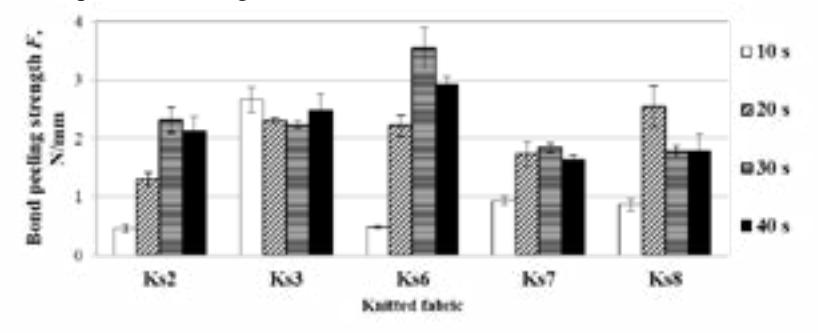
The highest value of bond peeling strength was determined for the bonds which were laminated for 30 s duration for the thickest (0.93 ± 0.01 mm) knitted fabric Ks6 (3.55 ± 0.35 N/mm) and the lowest – for Ks2 (0.69 ± 0.02 mm) bond when bonding duration was 10 s (0.46 ± 0.22 N/mm). The higher peeling strength is also seen for the bonds of knitted fabrics Ks2 (2.32 ± 0.22 N/mm) and Ks7 (1.85 ± 0.07 N/mm) which were bonded for 30 s. For Ks3 bonded system the highest value was determined when the bonding duration was 10 s (2.67 ± 0.21 N/mm) and for Ks8 – 20 s duration (2.55 ± 0.36 N/mm). The lowest values almost for all the cases are determined when the duration is 10 s.
When the amount of the elastane fibre increases in knitted fabrics from 10 % up to 20 % results show that bond peeling strength does not increase evenly, so there are no relevant dependencies in bond peeling strength.
The investigation of the influence of bonding duration on textile bonds peeling strength has shown that almost in all cases (Ks2, Ks6, Ks7 and Ks8) the bond peeling strength increases from 97.8 % up to 642.7 % when the bonding duration increases from 10 s up to 30 s. Bond peeling strength decreases from 22.4 % up to 129.3 % when the bonding duration from 30 s rises up to 40 s. It could be concluded that the bond peeling strength depends on bonding duration.