There is a huge demand for low cost, non-toxic and efficient energy sources. Such need is represented by vehicle and mobile devices markets. Increasing popularity of hybrid and electric cars as well as governments' actions are the reasons to develop more and more capacious energy storage systems. Lithium-ion batteries are now major sources and are still promising technology sector. One of the most important challenge in engineering of such systems is the choice of proper cathode material. Considering required properties: conductivity, energy storage capability, safety, costs and operating potential we have chosen lithium iron borate LiFeBO3 to be examined for this application.
Investigated material has theoretical gravimetric capacity of 220 mAh/g. Moreover, it is known that electrochemical charging/discharging of this material leads to a little change of volume ca. 2%. Also its conductivity value reaches $10^{-7}$ S/cm, what makes lithium iron borates a competitive material to those in common use [1, 2].
The conductivity of the material may be further improved by electrochemically non-active additives, like carbon. In our case, an innovative method of synthesis was acquired - firstly, the glass was obtained by quenching of a melt. In the next step, the obtained glass was subjected to thermal nanocrystallisation, when the nanocomposite containing small (50–60 nm) grains of LiFeBO3 was prepared. It has been reported, that nanocrystallisation of glassy material leads to improvement of its electrical properties, such as conductivity, even a few orders of magnitude [3, 4]. Taking into account good glass-forming properties of borates, it may result in promising cathode material.
Since the investigated material has not only a theoretical gravimetric capacity ca. 220 mAh/g [2], but also is safer and easier to obtain than popular LiFePO4 and LiCoO2 compounds [1], it has been characterised for suitability as a cathode material for Li-ion batteries. Samples were prepared with melt-quenching synthesis method and then tested with X-ray diffraction (XRD), differential thermal analysis (DTA) and impedance spectroscopy (IS) methods. Afterwards, cathode material was obtained in both glassy and nanocrystalline form and has undergone electrochemical cycling performance tests, of which results we present hereby.
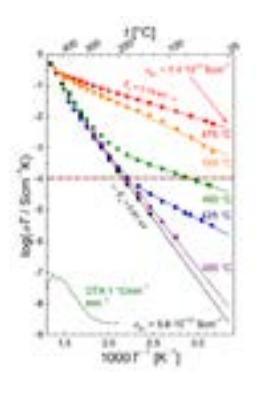
XRD diffractograms obtained for room temperature and temperatures between 375–700°C revealed that initially material was glassy. During the heating of the sample, there occured crystalline phases of Fe3BO5, LiFeBO3 and LiB3O5. DTA for 10°C/min served us in determining the temperature of glass transition (ca. 420°C) as well as three crystallisation peaks (458°C, 546°C, 647°C). Impedance spectroscopy examination showed, that heating has given rise to the conductivity value, lasting even after cooling the sample back to the room temperature – the biggest improvement was obtained for heating to 475 °C, where final value of conductivity was 1.4 · $10^{-5}$ S/cm. However, electrochemical tests on this material showed that the gravimetric capacity is only modest.