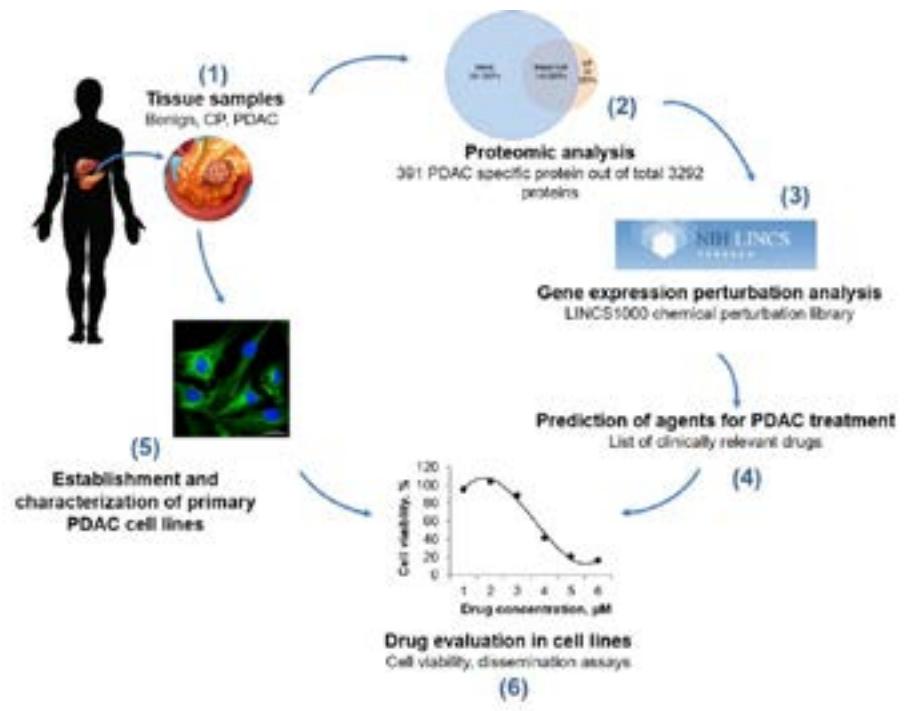
Pancreatic ductal adenocarcinoma (PDAC), the most common type of pancreatic cancer, is basically resistant to all mainstream cancer treatment modalities, such as chemotherapy and radiotherapy, and a surgical resection is effective for only 15-25% of patients [1]. Together with an unclear tumor subtyping system and the absence of treatment individualization strategies it makes PDAC one of the most hardly curable forms of cancer, bearing an average 5-year survival of patients, diagnosed with this disease [2]. The key to PDAC treatment could be targeting not only mutant malignant cells but the whole tumor as a system, consisting of cancerous cells in complex relationship with extensive stroma. On the other hand, almost no molecular signatures for individualized treatment for pancreatic cancer have been provided so far.
The present study combines proteomic analysis of PDAC surgical specimens and drug testing in patient derived primary cell culture in search for effective PDAC treatment. We performed high-throughput differential proteomic analysis of tissue samples taken during operations of patients with PDAC, chronic pancreatitis (CP) and those without these diseases. Differentially expressed PDAC-specific proteins (DEPs) enabled us to identify a set of proteins specific to pancreatic cancer but not pancreatitis patients. By comparing proteomic data to the databases of gene expression perturbation with small molecules we extrapolated a shortlist of chemotherapeutic compounds for evaluation as potential drugs for PDAC treatment: sorafenib, BGJ398, ASP2215, afatinib, 17AAG, ABT737. The efficiency of the drugs was assayed using primary patient-derived PDAC cell cultures. All of the drugs except for ABT737 significantly slowed down proliferation of primary cells in most PDAC cell cultures, and the combination of BGJ398 and ASP2215 was distinguished by exceptional efficiency. Most of the drugs also inhibited cell dissemination from spheroids and cell cycle to a various extent. Our results show a promising potential of this integrative pipeline for anticancer drug discovery and evaluation.