
The research of various population processes is an important stage in the understanding of different patterns of the group behavior inside the population. In our time, the society goes through a significant amount of thrills connected with unusual behavior models of individuals, such as homosexual behavior, abandonment of children, etc. Different scientific underpinnings can help in accepting of this kind of individuals by radical-minded people.
The simulation model of these processes allows evaluating them in different conditions and with a significant amount of cycles. This allows understanding the ways and under which conditions different behavioral models are the most efficient and are fixed in the population
The model simulates competitiveness for common resource between two groups. The first group (G1) consist of "parents" (individuals that are engaged in reproduction) and "helpers" (that are not engaged in reproduction, but potentially influence the intra-group process). The second group (G2) consist of "parents" individuals. We believe that conditions, in which the model group displaces the alternative group, may in the real biological evolution contribute to the alleles pinning, which foster the emergence of the "helper".
The most important part of the model is the competitive reduction. The competitive reduction was calculated with the algorithm [1] in which competitive reduction depends on resources, number of all groups after breeding and competitiveness of each group. You can find the model: http://dspace.univer.kharkov.ua/handle/123456789/14511.
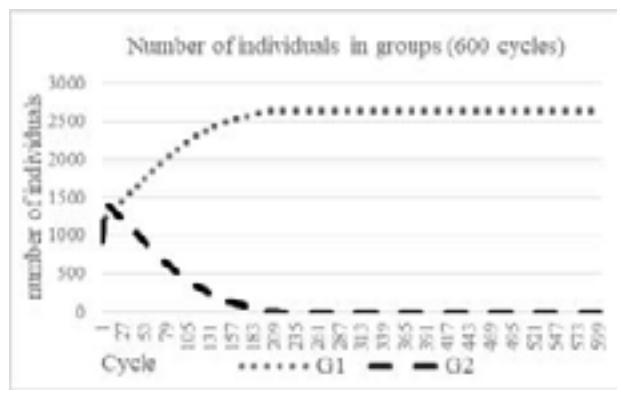
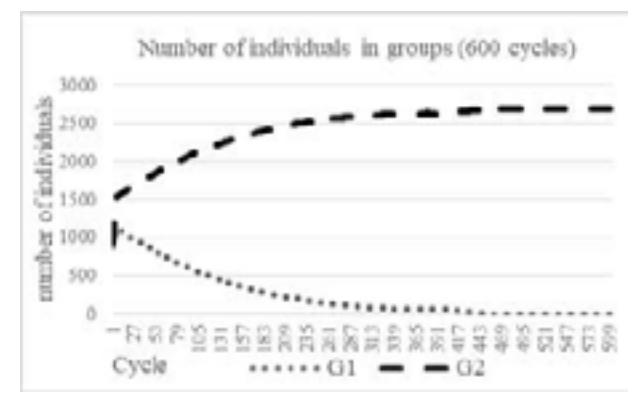
Influence of "helpers" on the population depends on many parameters: (i) number of "helpers"; (ii) fertility of parents; (iii) surviving of individuals; (iv) competitiveness of individuals; (v) assistance of "helpers". Fig. 1 shows positive influence of "helpers" optimal number on competitiveness of progeny. As a result, G1 displaces G2. Fig. 2 shows that big percent of "helpers" reduce their positive influence and G2 displaces G1. A similar process is observed when assistance of "helpers" from Fig.1 decreases to 50% (all another parameters stay the same). Therefore, G2 displaces G1. Relatively low decrease in adult survival in both groups (for example, to 80% on Fig. 1) also can lead to G2 expansion.
So, groups that include "helpers" (individuals that don't reproduce but influence the intra-group process through raising children etc) get huge evolutionary advantage in case of competition for resourses. Unfortunately, this advantage is possible only in relatively rare cases characterized by a combination of certain parameters that were discussed below. However, if groups develop with such parameters, discussed behavior patterns can spread.