The very first description of the alluaudite structure was given by Fisher in 1955 [1], and the investigation was carried out on natural minerals. The ideal composition of alluaudite -KxM3(PO4)3, where K = Na, Li, Ca etc., M = Fe, Mn etc., $0 \le x \le 4$ — was established by Moore [2]. Present knowledge of alluaudite structure comes from Hatert [3]. An alluaudite material of composition NaxMnFe2(PO4)3 attracted much interest of Trad and co-workers [4], since its theoretical gravimetric capacity could be close to 170 mAh/g if reversibly cycled between x = 0 and 2. Because electrochemical performance in polycrystalline materials was not spectacular, it was concluded that to improve its performance, nanomaterials are demanded.
Therefore we decided to synthesize amorphous analogs of alluaudites and apply properly planned heat-treatment. In previous studies on amorphous analogs of cathode materials for Li-ion batteries [5], a significant increase of electrical conductivity was observed as a result of this approach. It was suggested to be correlative with developing 10 nm size nanograins, which provide convenient conditions to polaron hopping mechanism of conduction.
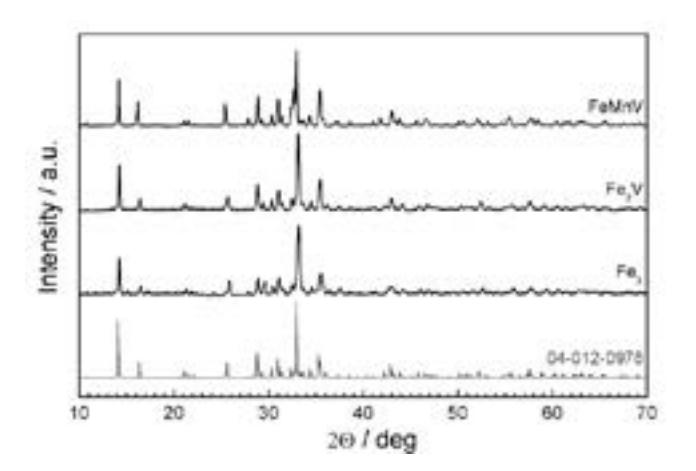
In this work, we have proven the possibility of preparation of glassy alluaudites and that their crystallization is consistent with foregoing works [2-3]. We successfully synthesized glasses of nominal composition Na2M3(PO4)3, where M3 = Fe3, Fe2V, FeMnV. Their thermal nanocrystallization led to nanomaterials isostructural with Na2MnFe2(PO4)3 reference pattern (PDF no. 04-012-0978, Fig. 1). As expected, in preliminary measurements, a significant (7 orders of magnitude) and irreversible increase of the conductivity was observed as a result of this process.