
Recently modified biopolymers as cheap and effective sorbents are widely investigated. Among these, starch is biodegradable, renewable and relatively inexpensive biopolymer, which makes it attractive as an environmentally friendly material for industrial use [1]. The properties of chemically modified starches are very different from those of native starch. Cationic starch with positively charged functional groups can be used in the wastewater treatment processes in order to remove negatively charged organic and inorganic impurities.
Cationic starches of different DS were obtained by etherification of native potato starch (S) with 3-chloro-2-hydroxypropyl trimethylammonium chloride (CHPTAC) using NaOH and adding CaO. Molar ratios of reagents in the reaction mixture S: CHPTAC: NaOH: CaO are shown in Table 1. Reactions were carried out at 45 °C for 44-48 h and obtained cationic starches powders were purified by washing with isopropanol and water mixture and when followed by the Soxhlet extraction with methanol.
| Molar ratio of reagents S:CHPTAC:NaOH:CaO | Degree of substituti on (DS) | Reaction yield, % |
|---|---|---|
| 1:0.05:0.09:0.04 | 0.05 | 100 |
| 1:0.25:0.29:0.04 | 0.25 | 100 |
| 1:0.40:0.44:0.04 | 0.40 | 100 |
| 1:0.60:0.64:0.04 | 0.56 | 93 |
| 1:1.00:1.04:0.04 | 0.84 | 84 |
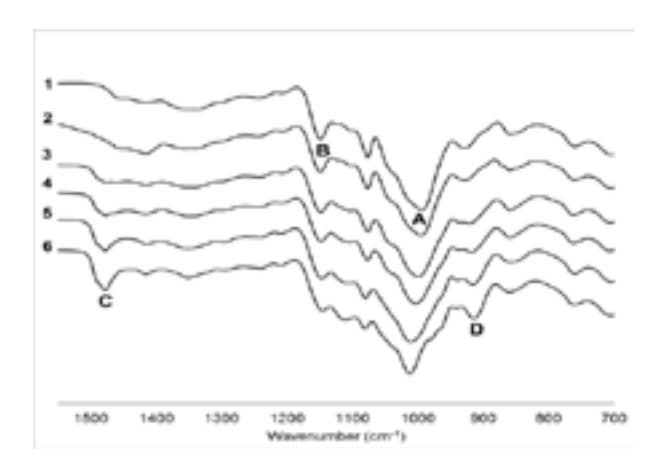
FT-IR spectra (Fig. 1) showed characteristic peaks of native starch and cationic starches. The strong band at 1008 cm-1 (peak A) is attributed to CH2–O–CH2 stretching vibrations, peak around 1152 cm-1 (peak B) is assigned to C–O stretching vibrations, and peak around 1480 cm-1 (peak C) is characteristic of C–N bonds of quaternary ammonium groups. Peak D at 944 cm-1 corresponds to the stretching vibrations of quaternary ammonium group.
Furthermore, the physical properties of CHPTAC modified starches were very much different from those of native starch. X-ray diffraction analysis revealed that degree of crystallization in synthesized cationic starches was lower than that in native starch. Moreover, the gelatinization of modified starches proceeded at higher temperatures than that of starch and maximum viscosity of paste during the gelatinization was significantly lower.