
The generation of a supercontinuum (SC) in a bulk material is an inexpensive and effective method for substantially expanding the spectrum of laser pulses. Accordingly, the broad spectrum of SC makes it ideal for seeding an Optical Parametric Chirped Pulse Amplifier (OPCPA). Stable SC in the wavelength range from ~ 500 nm to ~ 1000 nm in a YAG crystal pumped with picosecond pulses [1] simplifies TW-class laser architecture [2] due to the inherent signal and pump synchronization in OPCPA. Moreover, a stable SC in the range up to 2.5 μm would eliminate the idler generation and pave the way for the development a more reliable and compact OPCPA in the IR spectral range.
Besides the stable SC in the range ~ 500 nm to ~ 1000 nm, we observed single-filament SC spanning from ~ 1100 nm to more than 2400 nm with pulse energy stability and beam pointing stability exceeding the Chirped Pulse Amplifier (CPA) - compressor [2] used as a pumping source. Such a highly stable source of broadband seed pulses together with an inexpensive CPA-compressor based on Yb:YAG rods [2] significantly simplifies the development of compact high-intensity OPCPA systems around the 2 μm spectral range.
Compressed pulses with energies up to 16 μJ, pulse width of 1.15 ps and excellent beam quality M2 < 1.1 at a wavelength of 1030 nm were chipped off from a two-cascaded double-pass CPA-compressor based on Yb:YAG rods. These pulses were used to generate SC in YAG rods 15 mm and 130 mm long. We optimized the energy of the incident pulses, the focal length, numerical aperture and position to achieve the best spectral envelope and energy stability of SC, an excellent beam quality and reduced beam pointing fluctuations.
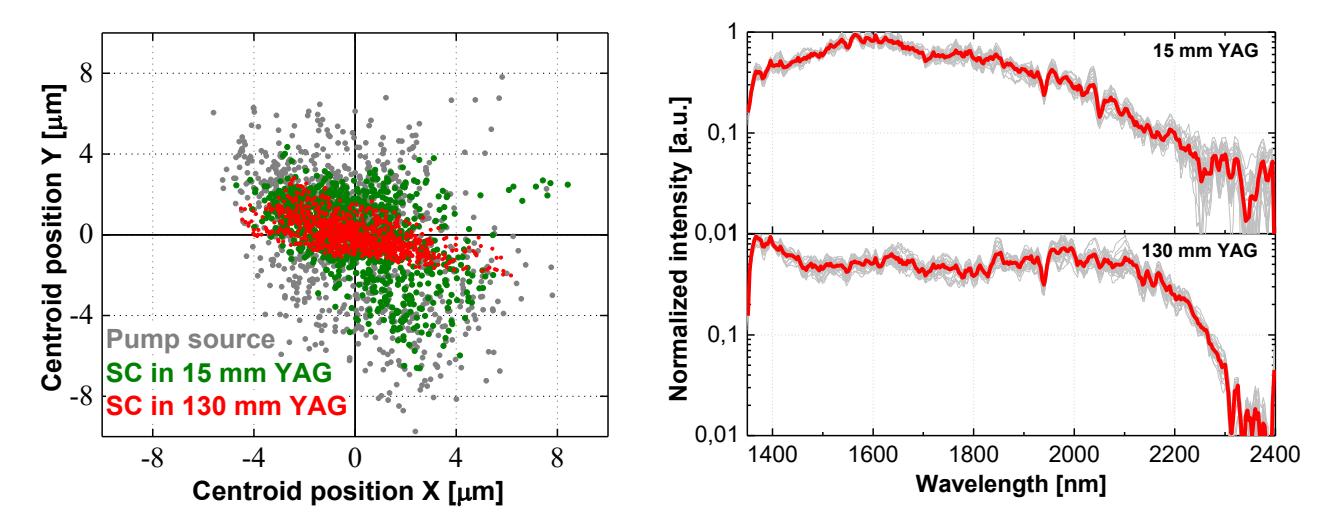
Under optimal conditions, the energy stability of the SC, measured in the wavelength range from 1050 to 2500 nm, is 2 times better than the stability of the incident pulses for a YAG rod with a length of 130 mm, and for a 15 mm rod – 30% better. Beam pointing stability of SC exceeds the source by a factor of 2.3 for a YAG rod 130 mm long and 2.7 times for a rod 15 mm (Fig. 1, left). Collimated SC has a Gaussian spatial distribution. Moreover, under optimal conditions, we did not observe any deterioration in the beam quality or the spectral envelope when tested for stability for 1 hour (Fig. 1, right) at a repetition rates of 100 Hz (over 360 thousand shots).