Organic photovoltaics (OPV) has been steadily progressing as one of the alternative solar energy-harvesting technology, ever since their first appearance over three decades ago [1]. Favorable properties such as lightness, flexibility, transparency and low-cost encouraged the research in materials design, device engineering and photophysical processes study. Even though one of the main photovoltaic parameter, solar-to-electrical power conversion efficiency (PCE), has remarkably increased since OPV appearance, now exceeding 16% for single-junction OPV devices, yet it falls behind state-of-the-art silicon or perovskite photovoltaic technology [2]. In recent years, the inventive substitution of well-established fullerene type acceptors by small low-bandgap molecules has led to a significant PCE increase. Such gain was enabled by numerous advantages of non-fullerene (NF) molecules over fullerene-based acceptors, including a broader absorption spectrum, which leads to higher short-circuit current and tunability of energy levels, enabling the open-circuit voltage gain. The superior photovoltaic performance of NF based OSCs is also believed to originate from the favorable morphology and charge dynamic properties in blends; however, the understanding of the latter is still very obscure and requires more in-depth investigation.
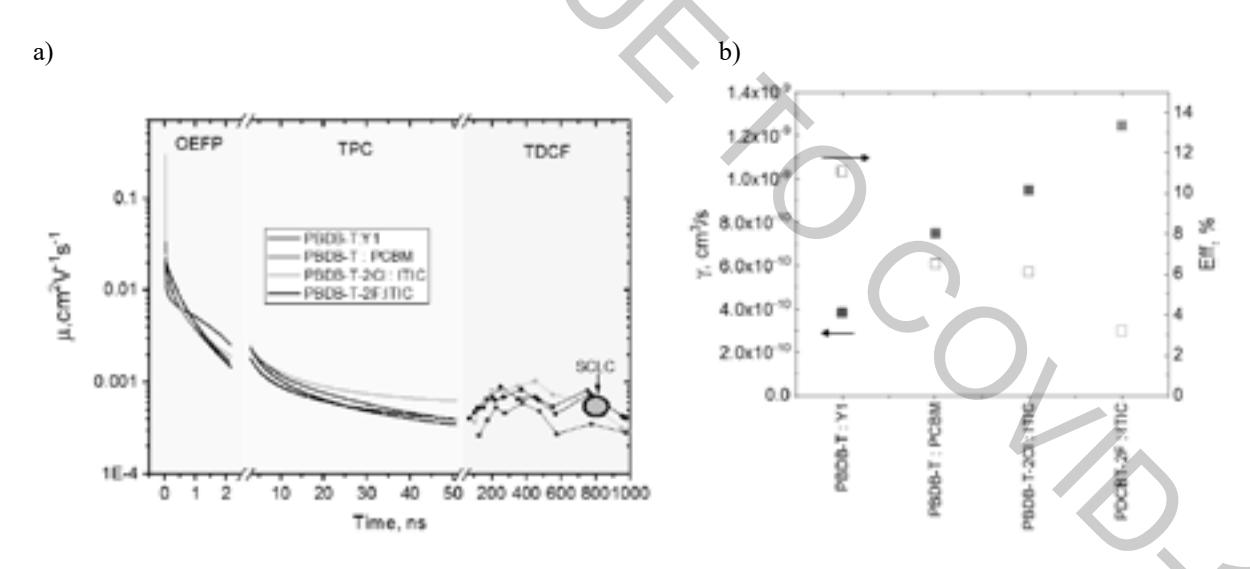
In this work, we use several time-resolved electro-optical measurement techniques covering an exceptionally wide time span (from sub-ps up to μs) to study the whole life cycle of photogenerated charge carriers, starting with their generation and finishing with extraction. We intently inquire into carrier mobility kinetics and disentangle geminate and nongeminate recombination processes in various bulk heterojunction systems. We comparatively investigated OPV systems comprising the well established PBDB-T donor molecule blended with either novel NF acceptor Y1 or archetypal PC71BM acceptor. Additionally, were investigated, BHJ systems based on benchmark NF acceptor ITIC with PBDB-T-2Cl and PDCBT-2F donor materials specifically chosen to have small HOMO level offsets.