Ever since the first demonstration in 2004, van der Waals heterostructures have received considerable attention due to their unique interlayer coupling and optoelectronic properties. Therefore, such heterostructures can benefit the performance of photodetectors, solar cells or other optoelectronic devices by reducing surface recombination velocity. Sb2Se3 is a quasi-one-dimensional material that can form van der Waals heterostructures on other low dimensional or three-dimensional substrates and has been shown to exhibit excellent optoelectronic properties [1, 2]. However, despite few experimental works, the growth mechanism of Sb2Se3 on low dimensional substrates is elusive.
Under equilibrium conditions, the growth of low dimensional materials is governed by van der Waals epitaxy. As in classical epitaxy, the growing layer adopts specific orientation to minimize lattice mismatch. The structure of Sb2Se3 resembles that of the molecular crystal, therefore the epitaxial relationship on the specific substrate can be estimated through relatively simple algorithm [3]. Therefore, in this work, we aim to predict the orientation of low dimensional materials grown on the specific substrate.
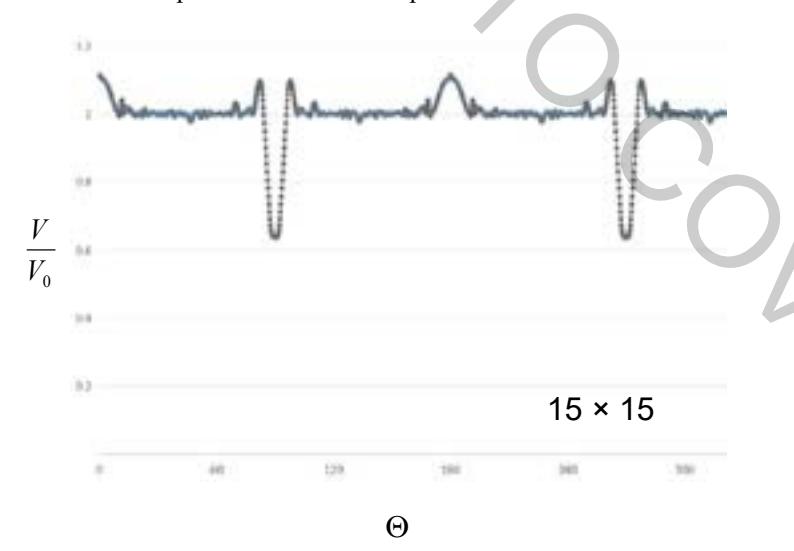
As a case study, we chose to examine epitaxial relation of Sb2Se3 and muscovite mica. The determination of the optimum overlayer orientation was accomplished using a simple geometric lattice misfit modelling algorithm that calculates a "dimensionless potential":
$$ \frac{V}{V_0} = \left(1 - \frac{\sin(M\pi p_x)\sin(N\pi q_x)}{2MN\sin(\pi p_x)\sin(\pi q_x)} - \frac{\sin(M\pi q_y)\sin(N\pi p_y)}{2MN\sin(\pi q_y)\sin(\pi p_y)}\right);\tag{1} $$Here the integer numbers M and N define the size of the overlayer, and the values of $p_{x,y}$ and $q_{x,y}$ are defined by a transformation matrix that relates the overlayer lattice vectors $\mathbf{b}_{1,2}$ to the lattice vectors of the substrate $a_{1,2}$ [3]. For muscovite mica substrate, the values were taken $a_1$=5.18Å and $a_2$=8.99Å with a perpendicular angle, and for Sb2Se3 various orientations of the layers and vectors' $b_{1,2}$ lengths were taken for the calculations.
Out of 10 tested planes with miller indices of (hk0), where h varied in 1 to 3 and k in 1 to 5 range, the (120) indicated the point-on-line coincidence at azimuthal angle at $\theta$ ~90 and 270 deg. A fair agreement was found with experimental results available in the literature. The existence of lattice coincidence verify that molecular crystal lattice misfit modelling algorithm can be suitable for prediction of Sb2Se3 morphology and orientation, and could be helpful in van der Waals epitaxial growth of 1D/2D p-n heterostructures optimization and selection of the substrates.