
During recent times the development of perovskite solar cells has flourished, as efficiencies as high as 22% was reached. This signals a potential, cheaper substitute for conventional silicon-based ones. However, many characteristics of perovskite films are still not fully understood. One of such is the photo-induced enhancing of photoluminescence (Fig. 1) and longer carrier lifetimes (Fig 2). In our study, we try to further identify the causes of such behaviour.
In MAPbI3 perovskite crystal methylammonium site is surrounded by neighbouring iodide ions which are a part of corner-sharing PbI6 octahedra. These iodide ions are known to migrate from their ground state in room temperature, creating defects in the crystal structure [1]. So far, it is proposed that light irradiation promotes recombination of iodide to its initial state, thus increasing the overall quality of the crystal [2]. To further identify these processes, we used different light soaking sources and various sample ageing conditions to determine how exactly photo-induced charges affect the migration of iodide ions and passivation of positive charge vacancies.
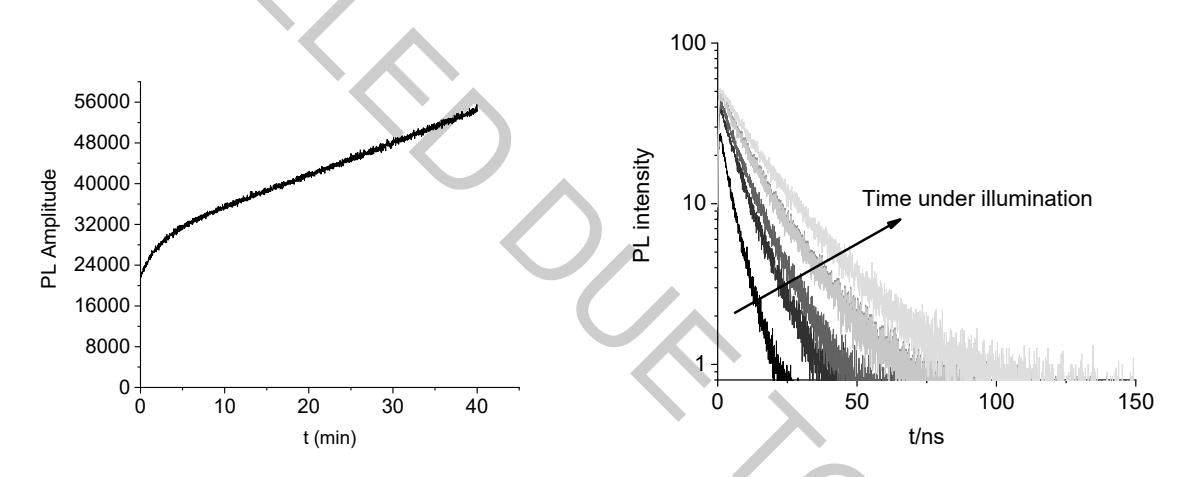
Main experimental methods used were time-dependent PL amplitude measurements and PL kinetics via 470nm laser excitation. The samples were prepared using a solution-based spin-coating process on interdigitated combs, followed by annealing at 100°C. From our measurements, we notice that there might, in fact, be two precesses that govern this behaviour, which are dependant on sample ageing conditions. One is noticeable in the first minutes of soaking while the other stays active for longer periods of time. However further research is needed and we hope to get some insight on the differences of these processes in the future.