In recent years hybrid lead halide perovskites have received exceptional attention in the scientific community due to their potential application in photovoltaic devices. Solar cells based on these hybrid compounds have already reached the power conversion efficiency of more than 20%. These materials do not only have superior physical properties, but they are also highly tunable due to a variety of organic and inorganic materials that can be incorporated into such hybrid structures [1]. Hybrid lead halide perovskites are composed of lead Pb2+ centers joined together by halogen (Cl-, Br-, or I-) anions into a porous framework. Each pore confines a single molecular cation (CH3NH3+, CH3NH2NH2+, etc.). The majority of such perovskites exhibit structural phase transitions followed by the cation ordering and framework deformation [2]. Among many techniques used for characterization of crystal properties, solid-state nuclear magnetic resonance (NMR) spectroscopy is an exceptionally effective method in studying structural phase transitions and dynamics [3].
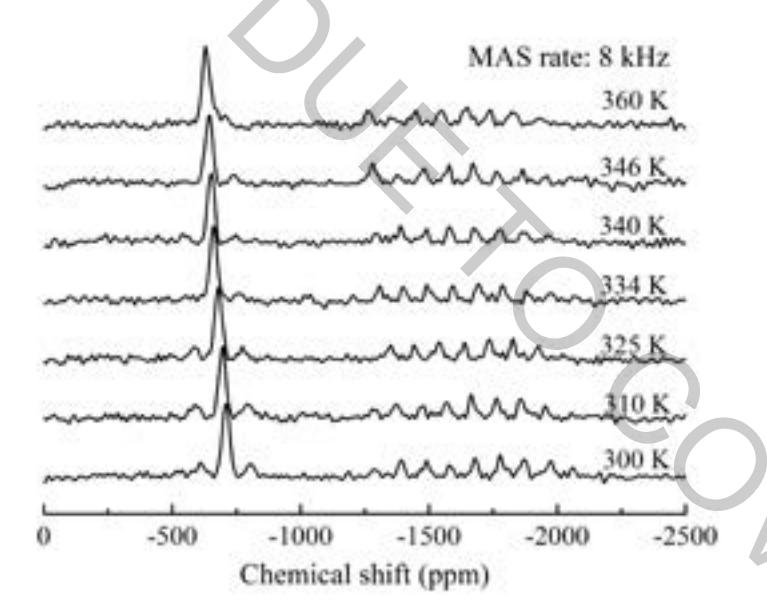
In this work we present a 1H and 207Pb NMR study of methyl-hydrazinium lead chloride CH3NH2NH2PbCl3 hybrid perovskite using the magic angle spinning (MAS) technique. In this crystal lead centers are linked with chlorine ions forming a three dimensional framework with two different types of PbCl6 octahedra. Each pore contains a single MHy+ cation which is bonded to the PbCl3- framework. Upon heating this material exhibits a structural phase transition at around 340 K. 1H NMR experiments show a broad signal which is not being affected by the phase transition. 207Pb NMR measurements demonstrate two signals (see Fig. 1) which represent two differently deformed PbCl6 octahedra. The temperature dependence of these spectra in Fig. 1 and their parameters define various properties of the phase transition.