
Cadmium sulfide (CdS), cadmium telluride (CdTe) and cadmium selenide (CdSe) are three of the II-VI compounds that have played a diverse role in investigating and seeking to use phenomena involving the interaction of light with semiconductors. In their pristine form, the electrodes normally exhibit low light-to-electricity conversion efficiency [1].These compounds have been studied both as single crystal materials, and as thin-film materials [2].CdTe is a material with a high absorption coefficient [3] and is mainly used in solar cells, finds application in IR detectors, radiation detectors, electrooptic modulators [4]. Cadmium sulfide has wide direct bandgap and high stability [5]. CdS is a semiconductor, which has a worldwide interest in photocatalytic applications [6].
Polyamide 6 films used in this study were obtained from Ensinger (Germany). PA 6 film was 500 μm thick with the density of 1.13 g/cm3. Prior to the experiments, PA film 15×70 mm in sizes were boiled in distilled water for 2 h (Sample 1). Other samples were stored in concentrated acetic acid at 20 °C for 0.5 h (Sample 2). Then they were dried using a filter paper and kept in a desiccator over anhydrous CaCl2. The salts of potassium telluropentathionate (K2TeS4O6·1.5H2O), were prepared and chemically analyzed according to published procedure [7]. In the first stage, the PA 6 films were chalcogenized from 1.0 to 5 h at 20 °C, using a continually stirred acidified (0.2 mol·dm-3 HCl) 0.1 mol·dm-3 solution of K2TeS4O6. In the second stage, the samples of chalcogenized PA were treated with the 0.1 mol dm-3 solution of cadmium acetate, (Cd(CH3COO)2·2H2O), for 10 min at the temperature 80 °C.
UV-VIS spectra were recorded on a Spectronic® Genesys™ 8 UV/VIS spectrophotometer with compensation of the absorption of PA 6, the range of 200–800 nm.
UV-VIS absorption spectral analysis of the chalcogenated PA 6 films showed that the absorbance of polyamide 6, sample 1 was significantly lower than PA 6 sample 2, which absorbs and diffuses more telluropentathionate, $TeS_4O_6^{2-}$, ions into the films thus treated [8].
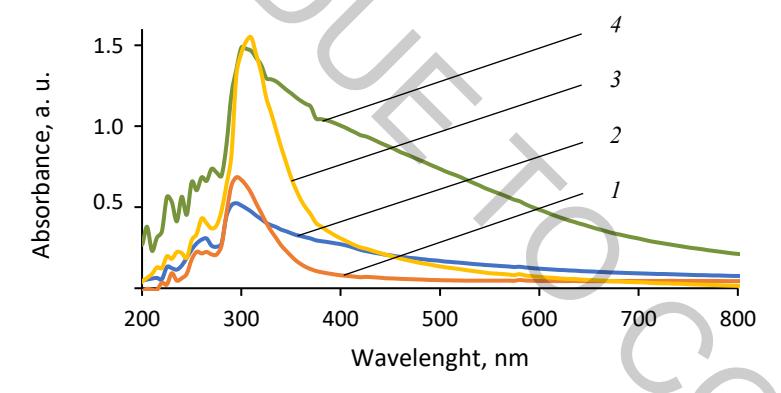
After interaction of the chalcogenated PA 6 with cadmium ions, peaks at 220, 245 and 260 nm are observed in the UV–VIS spectra. The absorption maximum at 295-310 nm is slightly lower in intensity and significantly wider (Fig. 1). Sample 1 after interaction with Cd(CH3COO)2·2H2O, reached peak intensities at 0.275–0.593 nm. Otherwise sample 2 – has more intense peaks – from 0.767 to 1.668 nm. These changes in absorption are thought to indicate the formation of cadmium sulfide-cadmium telluride following the interaction of chalcogenated PA with cadmium ions.