
The Panchromatic Hubble Andromeda Treasury (PHAT) survey is a Hubble Space Telescope (HST) multi-cycle program which obtained images of one third of the Andromeda (M31) disk in six filter passbands, ranging from near-ultraviolet to near-infrared wavelengths. High spatial resolution of HST has allowed to identify thousands of new clusters that were previously inaccessible with existing ground-based surveys. All of the detected clusters were sorted out into three categories: star cluster, galaxy, and ancillary [1].
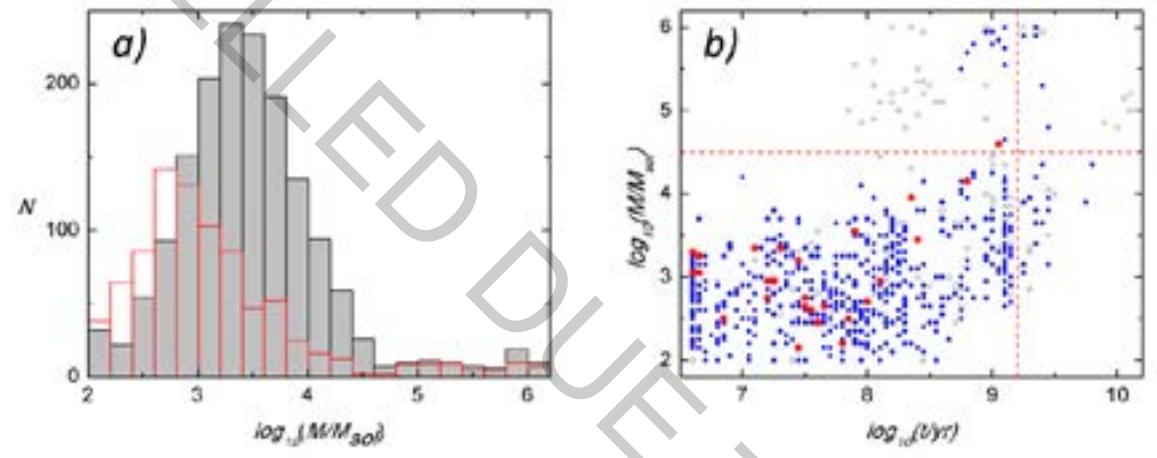
The aim of this study is to analyse properties of all detected star cluster candidates in the Andromeda galaxy. Age, mass, and extinction parameters were estimated using a probabilistic technique, which accounts for stochastic effects in star clusters. For some objects derived parameters were degenerate, thus we separated clusters into three groups according to photometric uncertainties (see Fig. 1b). Example of mass parameter distribution is shown in Fig. 1a. We have demonstrated that objects from the ancillary catalogue are less massive and dimmer comparing to star clusters from the main catalogue. Therefore, we significantly supplemented the star cluster catalogue of the Andromeda galaxy.