
Supercontinuum (SC) generation, also known as a spectral superbroadening, is an effect produced by filamentation of ultrashort laser pulses in dielectric media and resulting in a broadband radiation with high spatial and temporal coherence [1]. Thanks to these unique properties, SC finds diverse applications in spectroscopy, ultrafast nonlinear optics and photonics [2]. The most durable and reliable nonlinear materials to generate stable and reproducible SC in the visible and near-infrared spectral regions are sapphire and YAG crystals, which have high optical nonlinearity, wide band-gap, wide transmission range and high damage threshold. Many in depth studies have been conducted on SC generation in transparent bulk materials at low (1 kHz) pulse repetition rates [3,4]. Nowadays, high (hundreds of kHz or more) repetition rate lasers became available. However, no research has been done on production of SC with femtosecond lasers at high pulse repetition rates.
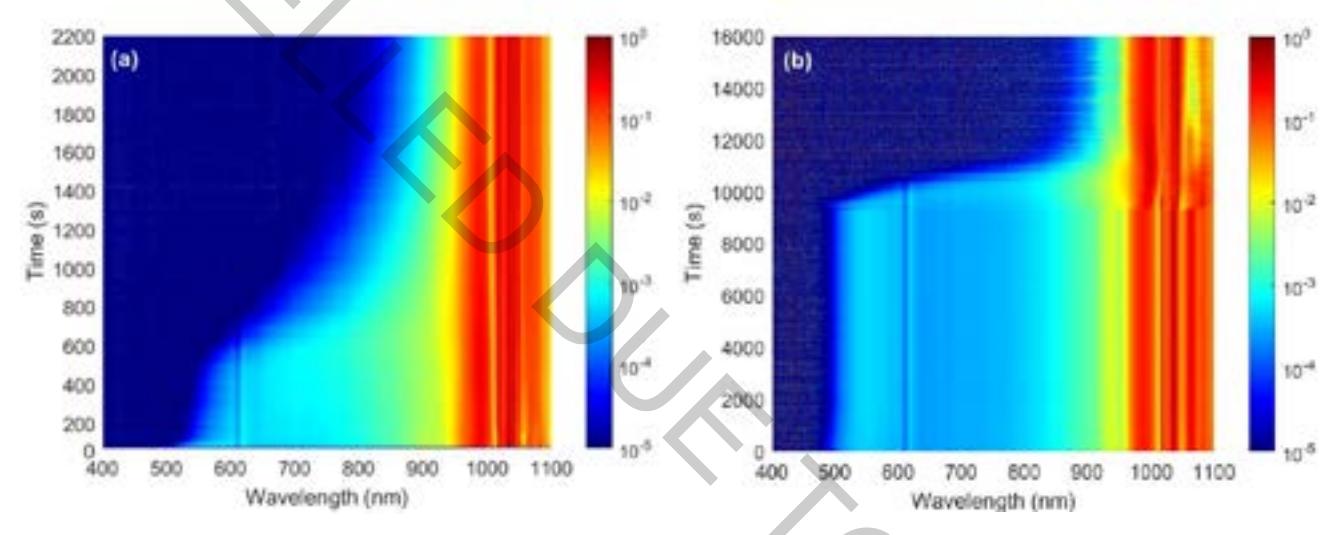
In this study, we experimentally investigated SC generation in sapphire and YAG crystals pumped with amplified Yb:KGW laser emitting at 1030 nm, having a pulse duration of 180 fs, and a high repetition rate of 200 kHz. The time evolution of SC spectra in tight (NA = 0.083) and loose (NA = 0.025) focusing conditions in sapphire crystal were also measured.
We observed similar SC spectral widths for both sapphire and YAG crystals ranging from visible (490 nm) to near-IR spectral range. The time evolutions of SC spectra in sapphire and YAG were investigated (Fig. 1). Our study revealed that the SC spectrum shrinks much faster in sapphire (~15 s) than in YAG (~2.5 hours) under the same experimental conditions with NA = 0.083. Our results show that production of damage-free SC in sapphire at high repetition rates could be significantly increased by choosing low NA focusing conditions. However, compared to sapphire, YAG is much more resistant even in tight focusing conditions. We believe that our findings provide insight for optimizing SC generation conditions such as beam focusing geometry and energy at high femtosecond laser pulse repetition rates, which could lead to improved system stability necessary for many practical applications.