
Metal-organic frameworks (MOFs) are extensively studied hybrid materials due to their potential applications in gas storage and separation systems and multiferroic memory devices [1, 2]. These coordination networks are formed from various organic linker molecules and metal centers that constitute porous structures. In the so called dense MOFs, the pore system inherently confines molecules, which are tightly bound to the framework. The most popular class of dense MOFs is metal-formate frameworks, which often exhibit interesting ferromagnetic and ferroelectric properties. These compounds consist of transition metal ions linked by formate linkers into porous frameworks, where each pore confines a molecular cation. Many members of these frameworks exhibit structural phase transitions, related to molecular cation ordering and metal-formate framework deformation. A useful method to study local changes in formate frameworks is electron paramagnetic resonance (EPR) spectroscopy.
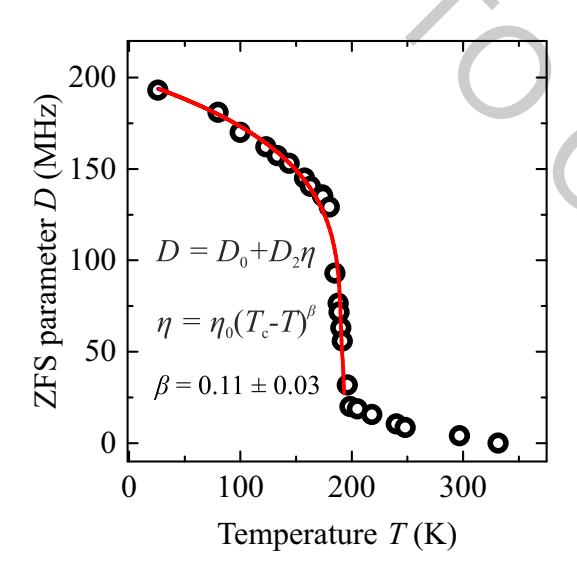
In this work we present X-band and Q-band continuous wave (CW), pulse EPR and electron nuclear double resonance (ENDOR) study of manganese doped [NH4][Zn(HCOO)3] (AmZnF) hybrid formate framework, which exhibits ferroelectric phase transition at 190 K. The CW EPR spectra obtained at different temperatures indicate successful substitution of the Zn2+ centers by paramagnetic Mn2+ ions allowing us to probe and characterize the structural phase transition. The obtained non-zero value of the zero-field splitting (ZFS) at low temperature shows the deformation of the MnO6 octahedra. The temperature dependence the ZFS parameter (presented in Fig. 1.) indicates the continuous character of the phase transition. CW EPR results are supported by the density functional theory calculations.
In order to study the broader environment of the Mn2+ probe ion, we performed pulse EPR experiments [3]. The two and three-pulse electron spin echo envelope modulation (ESEEM) measurements data indicates the interaction between Mn2+ center and protons. ENDOR spectrum shows the interactions of different protons with Mn2+ center. The two-dimensional hyperfine sublevel correlation (HYSCORE) EPR spectrum also indicates proton interactions and demonstrates the signal of 13C.