Imaging with terahertz (THz) radiation is appealing due to its non-ionising nature and transparency of many common industrial materials in the frequency range of 0.1 – 30 THz. However, many aspects of generation [1-2] and detection [3-4] of THz radiation are still under extensive research. A compact and sensitive THz detector with a fast response time is highly desired for the THz imaging systems.
In this work we investigate the performance of AlGaN/GaN bow-tie (BT) diodes as THz detectors in sub-THz frequency range at temperatures of 300 K and 80 K. The BT diodes were fabricated of Al0.25Ga0.75N/GaN high electron mobility transistor (HEMT) structures grown on semi-insulating SiC substrate [5]. A two-dimensional electron gas (2DEG) concentration $N_{\text{2DEG}} = 9.4 \cdot 10^{12}$ cm-2 and mobility $\mu = 1800$ cm2/V·s was found at 300 K from Hall experiment. At 80 K, these parameters changed to $N_{\text{2DEG}} = 8.6 \cdot 10^{12}$ cm-2 and $\mu = 15830$ cm2/V·s. Ohmic contacts were formed from Ti/Al/Ni/Au stack annealed at 830 °C for 30 s at nitrogen ambient. The resistivity of ohmic contacts was determined using transfer length method, providing values of less than 1 Ω·mm independent on temperature in the range of 300-80 K. For electrical isolation, a 700 keV energy Al+ ions were implanted into Al0.25Ga0.75N/GaN HEMT structures [6].
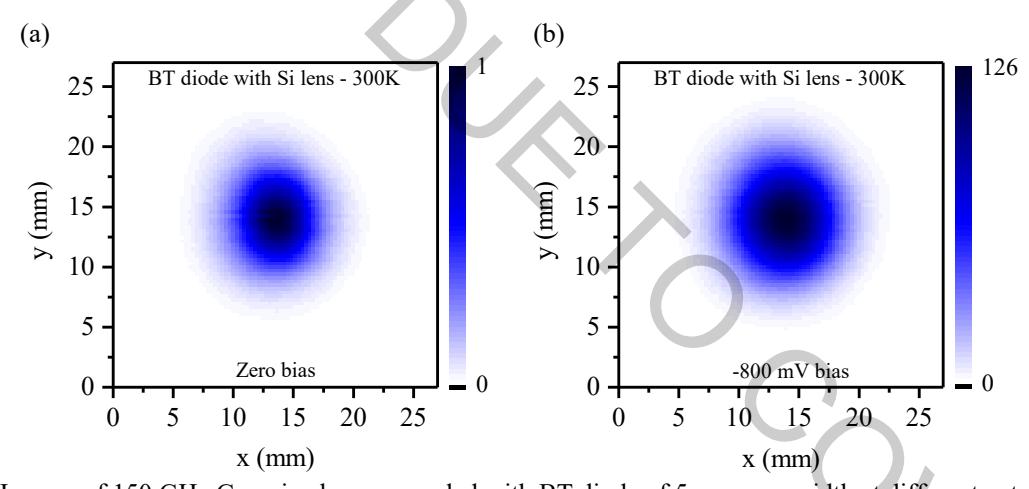
Operation of the BT diode, as a THz detector, relies on a non-uniform heating of carriers in the apex of geometrically shaped 2DEG layer under antenna-coupled electric field. Detection was studied using a quasi-optical illumination setup based on electronic multiplier chain source (VDI). Signal from detector was recorded using lock-in amplifier. Fig. 1 shows 2D profiles of 150 GHz Gaussian beam recorded with the 5 μm apex-width BT diode integrated with a hemispherical Si lens. The detected signal without applied bias was of 433 μV at the 300 K. An external bias of -0.8 V increased the signal by 20 dB resulting in the decrease of the noise equivalent power (NEP) from 249 to 4 nW/$\sqrt{\text{Hz}}$ under assumption that the Johnson noise dominated in the measurements. Further signal increase is expected at 80 K due to the increase of 2DEG mobility.